Your Business Exists on Google, But Does It Exist for ChatGPT? GEO Guide for Businesses
 Lucía Pérez · 23 Sep, 2026 · AI · 9 min

Imagine asking ChatGPT what the best tool is to solve a specific problem. The AI recommends three companies, summarizes the advantages of each, and even explains which one suits you best.
And here comes the worst part: your competition appears in the results, but your business does not.
It doesn’t necessarily mean their product is better. It could mean something much simpler: the AI has found enough evidence to understand and recommend it. In contrast, about yours, it has barely found information it can interpret, contrast, or use.
That’s where GEO, or Generative Engine Optimization, comes into play.
Yes, I know this name seems like another acronym created to complicate digital marketing, but behind this concept arises a rather practical question: how do you get an artificial intelligence to understand what you sell, who it’s for, and why it should include your business in a recommendation?
In this article, you will learn about it with actions you can apply in a small business, an online store, or a newsletter.
What is GEO?
GEO stands for Generative Engine Optimization, which we can translate as optimization for generative engines.
To understand the difference from a traditional search, let’s look at it better with an example.
If someone searches on Google for “best email marketing tool for a small store,” they receive a page with various links. Each company tries to occupy one of the top positions.
If that same person asks an AI, they might receive a pre-prepared response: three tools, their differences, a recommendation based on budget, and some sources for further information.
In that second scenario, you no longer compete solely to appear on a list. You compete to be part of the answer.
SEO, AEO, and GEO: three acronyms that look too similar
There is no universally accepted boundary between AEO (Answer Engine Optimization) and GEO. In fact, many companies and specialists use both terms to talk about the same thing.
Even so, this distinction is useful to understand what each strategy pursues:
| Strategy | Main Objective | Example |
|---|---|---|
| SEO | Appear in search engine results | Get a product page to reach a relevant position on Google |
| AEO | Get content to directly answer a question | Ensure an explanation is used in a response about that query |
| GEO | Gain presence within a generated response, especially in mentions, comparisons, and recommendations | Ensure an AI includes your solution among the suitable options for that person |
GEO does not replace SEO. It relies heavily on its fundamentals: accessible pages, useful content, a correct technical structure, and trust signals.
We’ll see it a bit further down.
Google’s own guide on optimization for generative functions makes it clear: for Google, optimizing for its AI experiences is still part of search work.
What changes is the result you want to achieve. You no longer just seek a position and a click. You also want the AI to understand you, cite you, or include you when it narrows down all available options to a very small list.
And don’t confuse it with ads within ChatGPT. GEO works on the organic presence of the brand in responses, whereas advertising involves paying to appear in the chat identified as an ad.
Why should you start paying attention to GEO in your business?
GEO is still in an early phase. There are measurement tools, agencies, and teams working on it, but there is no formula that guarantees appearing in all responses.
That doesn’t mean it’s too early.
A Semrush study conducted in 2026 among 481 American professionals found that 85% had already modified their search strategy in some way due to AI. However, only 22% had fully integrated SEO and generative search into their strategy, execution, and measurement.
The opportunity is not in discovering a secret trick before anyone else. It’s in doing now a job that many companies keep postponing: organizing the information about your business and checking what version of the brand the AIs are building.
Because an AI may already be answering questions about your sector, the question is whether it uses your business as a reference, always recommends the same competitors, or poorly explains what you do.
This change is part of a broader transformation: people are moving from searching among links to asking directly.
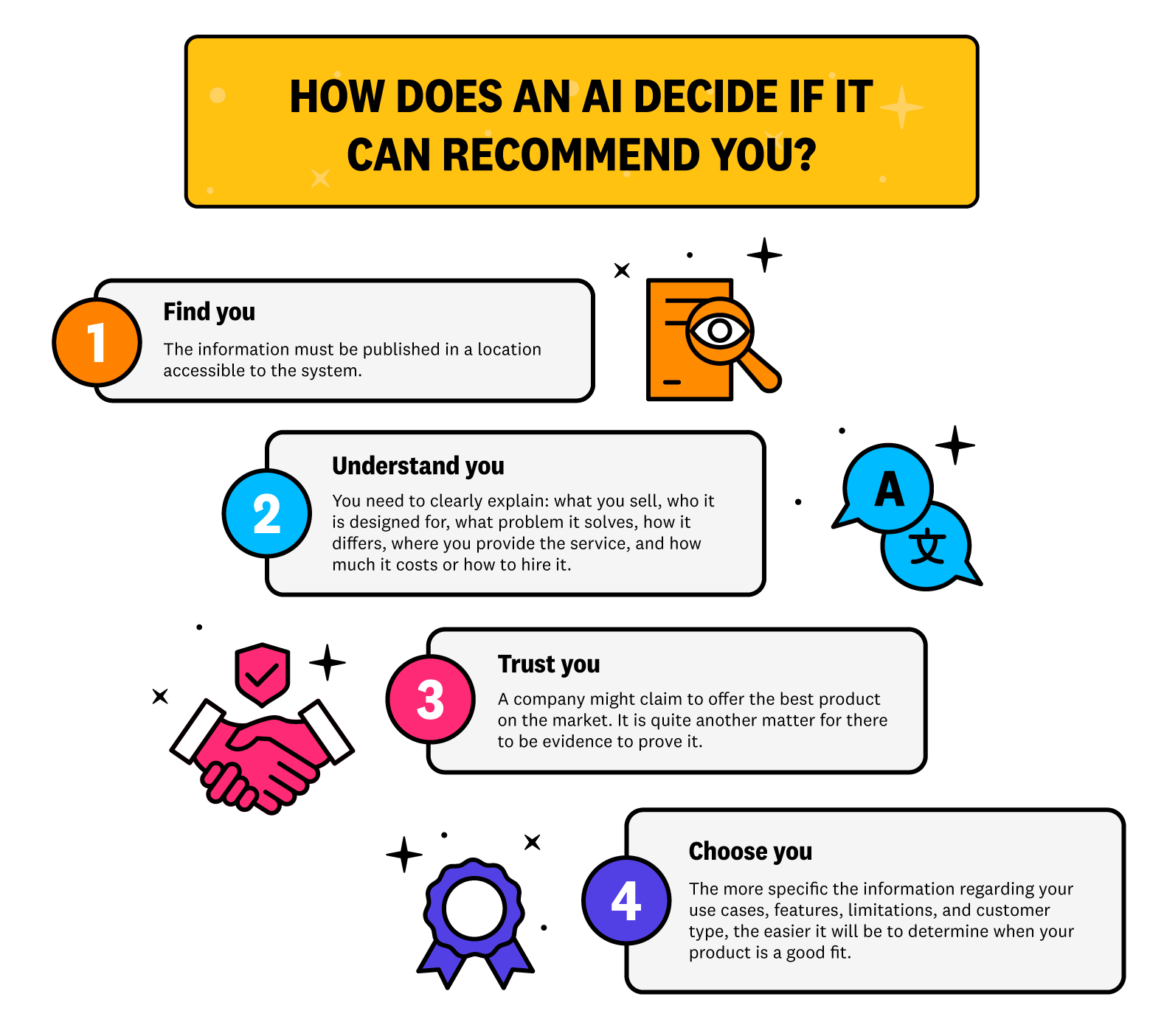
How does an AI decide if it can recommend you?
Not all generative engines work exactly the same. They can also produce different responses to the same query.
But for your business to have a chance of appearing, it usually needs to pass four tests.
- Find you
- Understand you
- Believe you
- Choose you
Let’s look at them one by one.
1. Find you
The information must be published in a place the system can access.
A blocked page, private content, or a store whose information only appears after executing complex processes have fewer chances of being retrieved than a public, indexable, and well-organized page.
This also affects newsletters. An email that only exists within your subscribers’ inbox does not function like a public page that an AI can consult.
We’ll return to this point later.
2. Understand you
It’s not enough for your website to exist. It has to clearly explain:
- What you sell
- Who it’s intended for
- What problem it solves
- How it differs
- Where you provide the service
- How much it costs or how to hire it
“Innovative solutions to transform your future” may sound good in a presentation. For a person (and a machine), it provides very little information.
“Email marketing software for SMEs that allows you to create campaigns, automations, forms, and SMS from a single platform” reduces ambiguity much more.
3. Believe you
A company can say it offers the best product on the market. It’s another thing for there to be evidence to support it.
Own data, real examples, identified authors, use cases, documentation, external sources, reviews, and independent mentions help build that credibility.
Here, GEO stops being solely a content task. It also affects the product, customer service, public relations, and brand consistency across different channels.
4. Choose you
Recommendations often include conditions or the famous long tail.
It’s not usually asked just for “an email marketing tool,” but for one that works for a small store, has support in Spanish, fits a certain budget, or allows sending SMS.
The more specific the information about your use cases, features, limitations, and type of customer, the easier it will be to determine when your product fits.
Hiding all the details behind commercial phrases may result in a shorter page. It can also leave the AI without arguments to include you in a comparison.
Do this test before changing your website
You can conduct a first GEO audit without hiring any tools.
Prepare ten questions a customer might ask before buying. They should represent real situations, not searches for your brand.
For example, in the case of Acumbamail, we could pose:
- What email marketing tool is suitable if I have a small store?
- What email marketing platforms offer support in Spanish?
- What is a European alternative to Mailchimp?
- What tool allows managing email and SMS campaigns?
- What platform can I use to create a newsletter without technical knowledge?
Then, test those questions in two or three AI assistants and record:
- What brands appear
- In what position they are mentioned
- What advantages the response attributes to them
- What sources it uses
- If your brand appears and how it describes it
- What competitors are repeated
Don’t turn a single response into a definitive conclusion. Results may vary depending on the model, timing, location, conversation context, and available sources.
The audit serves to detect patterns. If your company never appears or is described incorrectly, you already have a starting point.
How to prepare your website and content for GEO?
Once deficiencies are detected, it’s time to facilitate interpretation work.
Explain each product precisely
Each relevant service or product should have its own page. Include the problem it solves, its functions, the target profile, the price when possible, and the differences from other options.
Don’t force visitors to reconstruct your proposal by jumping between five different sections.
Publish content that not just anyone could sign
A generic explanation of “five advantages of email marketing” competes with thousands of almost identical contents.
An analysis based on your clients’ results, a test conducted with real campaigns, or a guide that collects errors observed by your team provides information difficult to replace.
Google recommends prioritizing original, useful content based on experience over texts that merely reorganize known information.
Identify who is behind the content
Include author, experience, publication date, and update date when relevant. If you make a technical statement or use a statistic, link to the original source.
The goal is not to fill the article with links. It’s to allow both the reader and the system to distinguish a documented statement from an opinion.
Maintain consistent information
Company name, description, products, prices, and target audience should match on the website, social profiles, directories, media, and external platforms.
If each channel explains a different version of the business, an AI will have more difficulty constructing a reliable description.
Review the technical part
Your content must be crawlable and indexable. It’s also advisable to maintain descriptive titles, useful internal links, reasonable load times, and correct structured data when applicable.
Structured markup helps describe certain elements of a page. In this practical guide on schema markup, you can check which types to use and how to implement them.
Even so, there is no special schema type that guarantees appearing in generative responses.
Here appears a nuance that often goes unnoticed: sending a newsletter does not automatically make its content visible to generative engines.
If the email only exists within a private inbox, it cannot be treated the same as a public page.
That doesn’t mean the newsletter is excluded from a GEO strategy. It means you need to decide which part of that knowledge you also want to publish openly.
You can do it in several ways:
- Activate a public web version of certain mailings
- Maintain an accessible and indexable newsletter archive
- Convert the best emails into standalone articles
- Publish a summarized version and reserve the full application for subscribers
- Create permanent pages from ideas developed over several mailings
- Link from the newsletter to related public content
This model allows the information to attract discovery from search engines and AIs, and the newsletter to continue doing another job: converting that occasional visit into a direct relationship.
Email allows that person to continue receiving your content tomorrow and to start building your own audience with first-party data, without relying on the same assistant choosing you again.
If you have an online store, the AI needs data
In ecommerce, an attractive description is not enough. Systems that compare products need concrete and updated information. It’s the step before a scenario of agentic commerce where the AI not only recommends but can also intervene in the purchase.
Check that each listing includes:
- Unequivocal name and category
- Price and availability
- Measurements, materials, and specifications
- Variants and compatibilities
- Recommended uses
- Shipping costs and times
- Return conditions
- Warranty
- Verifiable reviews
- Photographs that allow evaluating the product
It’s also advisable to keep product feeds updated. Google confirms that Merchant Center and its feeds can help display products in its traditional results and generative experiences.
Think of a query like “I need a waterproof backpack under 70 euros that can serve as cabin luggage.”
If your listing only says “the perfect companion for all your adventures,” almost all the necessary data to enter the comparison is missing.
If it indicates dimensions, capacity, waterproof level, weight, price, and compatibility with cabin measurements, the system has concrete criteria to evaluate the product.
Four GEO shortcuts that are not shortcuts
As with any new discipline, solutions promising quick results are appearing around GEO.
It’s advisable to put some in context so you don’t always fall for them.
Create an llms.txt file
The llms.txt is a proposed standard that offers models an organized version of a website’s relevant content.
It can be used as an experiment for certain systems, but it’s not a universal solution. Google expressly states that it does not use this file for its generative search functions.
Rewrite all texts “for the AI”
You don’t need to use artificial language or repeat all possible variations of a question. A clear structure helps, but the content still needs to solve a real need.
Publish hundreds of generic articles
More pages do not equal more authority. If they all repeat existing information, they add little value and can dilute the site’s overall quality.
Get fake mentions
Reviews, comparisons, and external mentions can influence how a brand is represented. Creating them introduces a reputational risk and does not build a sustainable signal.
How to measure if GEO works?
GEO does not yet have a perfect equivalent to checking a fixed position on Google.
You can start with a simple dashboard that periodically reviews:
- Percentage of queries in which your brand appears
- Competitors mentioned more frequently
- Sources cited by each assistant
- Features associated with your brand
- Errors or outdated information
- Traffic from AI assistants
- Registrations or sales attributed to that traffic
- Evolution of brand searches
Always use a stable set of questions and repeat each check. An isolated response may be anecdotal; a pattern maintained over several measurements allows for decision-making.
And remember that appearing is not the final goal. If an AI mentions you but poorly describes your product or recommends you for an audience that doesn’t fit, you have visibility but not useful visibility.
Start by leaving a footprint the AI can understand
You don’t need to redo your entire strategy to start working on GEO.
- First, ask.
- Then observe which companies appear, what arguments the AI uses, and where it gets the information.
- Finally, compare that response with what your website, product listings, and content actually explain.
In many cases, the first problem won’t be an unknown algorithm. It will be a too generic proposal, incomplete information, or valuable content locked in private channels.
GEO can help you enter the discovery moment, but after that first recommendation, you need a channel that allows you to maintain contact.
Here, email still plays a hard-to-replace role: turning a one-time appearance into your own audience.
With Acumbamail, you can create forms and landing pages, manage your contacts, and send campaigns so that those who discover you through a search (traditional or generative) don’t have to find you again from scratch.