Information Fatigue: How to Send Emails When Everyone is Overwhelmed
 Pablo Díaz · 12 May, 2026 · Email marketing avanzado · 5 min
Did you know that more than 370 billion emails are sent and received every day worldwide? (According to data from Statista). Email remains the marketing channel with the best return on investment, 42 euros for every euro invested, but its popularity is precisely what has made it a saturated channel.
Think about it: how many brand emails have you deleted this week without reading? If your subscribers do the same with yours, you have a problem called information fatigue.
In this article, we’ll see how we can remedy this.
What is email information fatigue (and why is it not just a matter of quantity)?
Email information fatigue is the subscriber’s psychological response when they feel that your emails cost them more than they provide. In other words: when opening your email becomes a burden instead of something useful or interesting.
Ouch, that’s hard to accept, isn’t it?
There are two main causes.
The first is excessive frequency: sending too much eventually exhausts even the most loyal subscribers.
The second, and less obvious, is the lack of relevance. A clothing store that sends three weekly emails with generic discounts causes the same fatigue as one that sends one a month but always about products the subscriber is not interested in at all.
Frequency matters, but content matters just as much or more.
By the way, here we talk about how to decide the ideal frequency for sending our email marketing campaigns.
The process is rarely abrupt. The subscriber doesn’t unsubscribe on the first day. First, they stop opening, then ignore, then delete without reading, and finally unsubscribe or, in the worst case, mark the email as spam.
For a business that has invested time and effort in acquiring each contact, losing it due to negligence is a mistake that can be avoided.
Why is the problem worse than ever?
44% of people unsubscribe from a mailing list because the sender sends them too many emails (according to data from Mindbaz).
That data alone is revealing, but there is something more recent that has accelerated this problem.
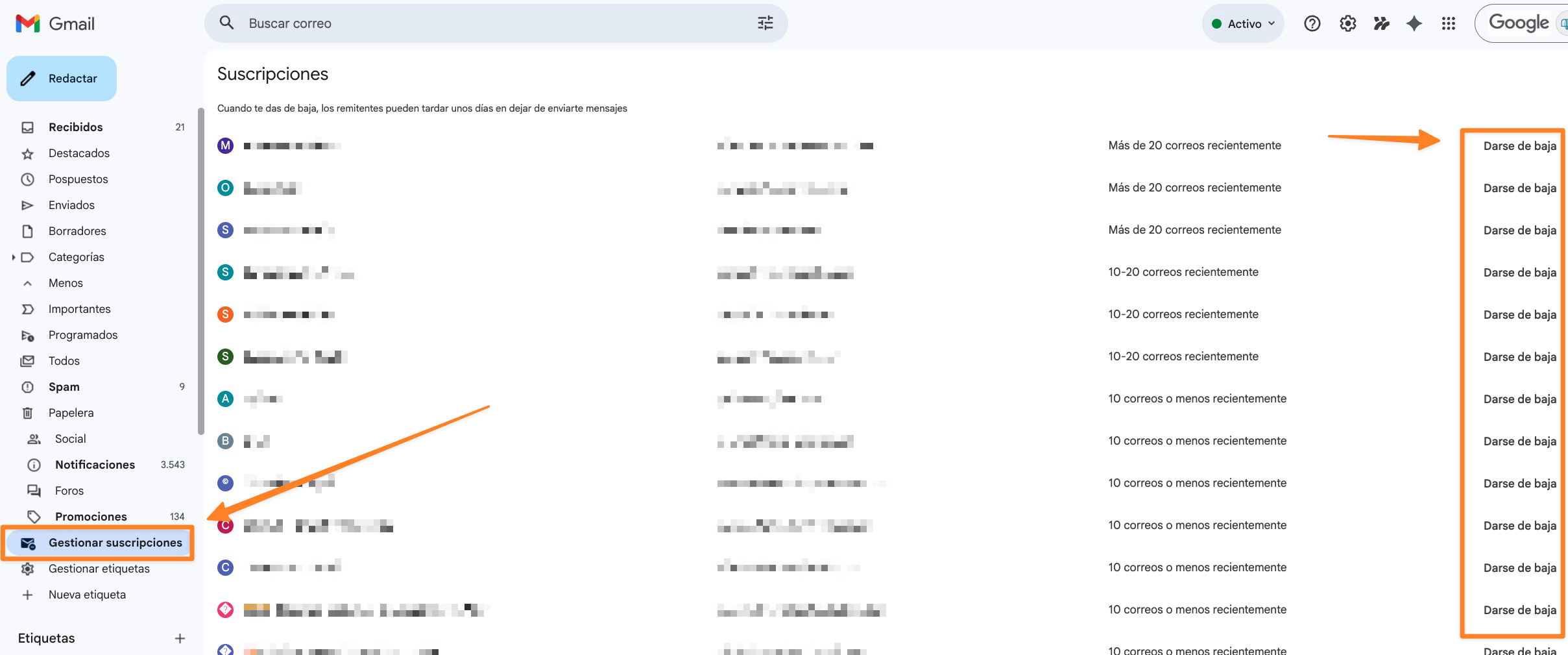
In 2025, Gmail made it easier to unsubscribe from promotional emails with a single click, practically eliminating all friction.
In the image, I show you the new tab that appears in the left menu:
To this, we must add the general context. Email doesn’t just compete with other emails: it competes with app notifications, WhatsApp messages, social media posts, and a constant avalanche of digital information.
When your email arrives in the inbox, it does so amid all that noise and to a person who has already spent hours processing stimuli. The bar for deserving to be opened is higher than ever and will continue to rise.
4 signs your subscribers are already fatigued
Fatigue doesn’t announce itself. It’s detected in the numbers. These are some of the metrics you should monitor.
- Drop in open rate
If your emails are opened less and less campaign after campaign, your subscribers are stopping paying attention to them. The average open rate in Spain in 2024 was above 43%. If you’re well below that figure and the trend is downward, something is wrong.
- Drop in CTR
They open the email but don’t click on anything. The content doesn’t engage or isn’t relevant to the recipient. It’s a subtler sign than the previous one, but just as important.
- Sustained increase in unsubscribes
A one-time spike after a specific send can be normal. A sustained upward trend over time is a clear sign of accumulated fatigue.
- Spam complaints
The most serious of all. When someone marks you as spam instead of unsubscribing, it means they don’t even want to take the time to find the clean exit.
Besides indicating fatigue, it directly damages your domain’s reputation and affects the deliverability of your upcoming campaigns.
There’s no need to obsess over the numbers with every send. Just review the evolution once a month and detect if there are negative trends before they become a bigger problem.
How to prevent fatigue before it appears?
The best way to combat fatigue is not to let it appear. These are the main levers, all applicable without the need for large resources or advanced technical knowledge.
Segment your list
Not all your subscribers have the same interests or are at the same buying stage.
A sports store that sends the same email to someone who bought running gear and someone who bought swimming equipment is missing a clear opportunity.
Dividing the list by behavior, interests, or purchase history allows sending messages that truly make sense to the recipient.
Here you can learn more about segmentations.
Mind the sending frequency
There is no universal perfect frequency. What does exist is a limit beyond which the subscriber starts to get tired, and 44% of unsubscribes occur precisely due to excessive sends (as we mentioned above).
The practical rule: send when you have something worthwhile to say, not to meet a schedule.
Personalize at least minimally
Using the subscriber’s name in the subject line or adapting the content to their purchase history makes a real difference in how the email is perceived. Advanced technology is not needed to start: with basic segmentation and the personalization fields available in any email marketing platform, a noticeable effect is already achieved.
Vary the type of content
If all your emails are promotions and discounts, the subscriber learns to ignore them. Alternating with useful content, business news, or more personal and direct emails keeps interest and makes each send not always seem the same.
What to do when the damage is already done? Recover your inactive subscribers
If when reviewing your metrics you detect the previous signs, not all is lost. The first step is to launch a reactivation campaign.
A reactivation campaign is a sequence of one or two emails aimed exclusively at subscribers who have not opened or interacted with your sends for a while.
The goal is not to sell: it’s to regain attention.
The scheme works like this. Imagine you have 300 subscribers who haven’t opened any emails in the last 90 days. You send them a first email with a direct subject line, something like “Shall we stay in touch?” or “We haven’t heard from you in a while,” accompanied by a simple incentive: an exclusive discount or valuable content that the rest of the list doesn’t receive. It’s important that there is a link to measure interest.
If they don’t respond, a second farewell email: “If we don’t hear from you in the next few days, we’ll unsubscribe you.” This honest and pressure-free tone usually generates more reactivations than any aggressive promotion.
If after that sequence the subscriber still doesn’t respond (or click on the link you provided), the smartest thing is to remove them from the list.
Keeping inactive contacts harms the deliverability of all your sends: email providers like Gmail or Outlook interpret the lack of interaction as a negative signal and start filtering your emails into the spam folder.
Remember: a small but engaged list always performs better than a large and inactive one.
To conclude
Information fatigue is not resolved by stopping email marketing or drastically reducing sends. It’s resolved by being more selective with what is sent, to whom, and when.
For a small business just starting, the advantage is that it still has time to build a healthy strategy from the beginning: well-segmented lists, relevant content, reasonable cadence, and constant attention to metrics. That’s what differentiates emails that are opened from those that are deleted without reading.
If you want to start applying all this without complicating things, Acumbamail provides the tools to do it: from campaign segmentation and personalization to reports that show you exactly how your subscribers are responding.