Graphic Design vs. Email Design: How to Design Newsletters?
 Yacarlí Carreño · 12 Feb, 2026 · Diseño Gráfico · 7 min

When we talk about marketing, design will always be key. In this article, we delve into email and newsletter design while providing some insights into the designer’s profile.
Is talking about graphic design the same as talking about email design? No.
To make ourselves clear: Graphic design is the art or profession, in general, the macro level.
Whereas, when we talk about email design, we refer to something micro, much more specific.
Even talking about marketing design is not the same as talking about email design, despite the fact that –obviously– some guidelines and fundamentals may be basic, useful, and shared. We could even be talking about the same language bases, but different communication codes.
Any design can be made by following the profession’s foundations. When specifically in a sketch we aim to achieve a concrete marketing objective, we talk about marketing design. And when –even more specifically– we create or think about an email design, it’s because we want to achieve a specific effect or actions in the subscribers/audience.
To design successful newsletters, we need to talk more about email design and marketing design than about graphic design as a general art.
An email made by a designer can be very beautiful, artistic, and attractive but –if it doesn’t follow the specific parameters of email design– it may not be successful, it could result in… nothing.
We believe that having this clear and making this distinction is key for personal brands, companies, and marketing teams. In general, for any type of client or person eager to send email marketing campaigns and especially needing to fine-tune and optimize resources and efforts.
Keep reading if you’re interested…
The Balance
Designing successful newsletters involves finding the desired balance. There’s no point in creating a beautiful email if it doesn’t have a clear focus or doesn’t offer a good user experience (UX), but neither can the basic principles of graphic design be ignored, which, as we mentioned before, are the foundations.
You can’t start building a house from the roof.
A well-designed email:
- Is attractive. Captures attention and sight.
- Guides navigation/reading.
- Highlights the main elements of the communication.
- Offers an image of professionalism/seriousness.
- Entertains on its own.
- Builds and unifies the corporate image.
- Is easy to read/consume.
- Generates differentiation.
- Leaves a good impression.
- Can create a connection with the audience.
- Pleases/appeals/enamors.

We emphasize this block because obsession with results is not good either. Sending attractive emails is still very important, even in a context where most email marketing platforms provide very simple templates that help small and medium-sized businesses send their emails without major complications.
Why?
The raison d’être of these templates is precisely that: to offer alternatives to those who don’t have them or can’t afford them yet. The templates found on platforms like ours comply with the basic principles of design, provide an aesthetic solution, help achieve an objective… especially because they have a distribution of elements that we believe could be optimal for achieving results.
However, these templates do not meet all the bullets we presented a couple of paragraphs ago. To captivate through design, achieve greater differentiation from the competition, and connect with the audience, there will always be a need for work and innovation in graphic design.
What else is missing?
We can’t talk about all this without the prior work of graphic design.
Before designing effective newsletters, it would be advisable to have a defined logo and graphic identity. From here, it would be recommended to take the next steps and work on everything else.
What is the relationship?
The best marketing specialists know that graphic design is one of the most powerful tools in their arsenal.
However, not all graphic designers are the same when it comes to marketing. Marketing specialists have specific goals to achieve and strategies to help them achieve them. For graphic design to have a real marketing impact, it is necessary to understand the difference between marketing design and graphic design. A designer who understands objectives and strategies is required. A marketing designer is needed (or at least work in tandem with one).
What does Graphic Design do?
It is “the art or profession of using design elements (such as typography and images) to convey information or create an effect”. In short, it is a broad discipline that adheres to a specific set of principles. These principles can be applied to an infinite variety of projects and industries.
That’s why there are different specialties within graphic design. Each specialty focuses on a specific application, such as marketing design.
What would marketing design be then?
The union of graphic design principles with the objectives of the marketing strategy. As a result, marketing design focuses on producing creative assets for specific marketing channels that highlight a company’s products or services (such as an email).
Marketing design ensures that marketing campaigns and materials hit the mark. It produces assets that are:
- Visually appealing.
- Align with brand identity.
- Create an emotional connection with the target audience.
The most common forms of marketing design include:
Digital ad design

The online advertising space is saturated, and the cost of advertising continues to rise. In this sector, automated bid management and budget allocation have leveled the playing field. Now, the only way digital marketing teams can influence the success of advertising campaigns is through creative development and testing. To develop all the creativity they need to test, digital marketers need designers with experience in digital ad design.
Content design
71% of B2B marketers say content marketing is more important in 2023 than last year (figures from IAB Spain). The rise of content marketing is not slowing down in the short term. Content design is crucial to ensure that content is clicked on, downloaded, and remembered.
Newsletter/email design
As we have mentioned before: email is the primary channel for boosting ROI, generating $36 for every $1 spent. Once a customer’s attention (and email address) is captured, they need to be further engaged with each email. A newsletter/email design capable of producing images and content attractive enough to persuade potential customers to click and convert is necessary.

Social media design
When done right, marketing on social media increases brand awareness and customer loyalty. Social media marketing strategies cannot succeed without good design. Quality social media design helps maintain brand consistency in posts, increases brand recognition, and attracts target audiences.
Landing page and website design
Marketing campaigns can generate many clicks, but websites and landing pages decide whether those clicks convert.
Print, packaging, and labeling design
From packaging and brochures to branded items, most businesses produce some type of physical promotional material (and it’s a significant investment). When the time comes to activate all that, a designer who can translate the brand’s visual identity into a series of physical elements and products will be needed.

Video and animation
65% of customers report watching videos more than once a day, and brands want to capture that valuable attention. It’s no surprise that companies continue to increase their video marketing budgets. Producing quality video content that works requires time and professional input, but the potential ROI is certainly worth it.
Back to our topic:
How to approach marketing design?
- Review the marketing strategy, business objectives, and different tactics.
- Meet with a designer and assess which pieces are possible and necessary to produce.
- Define which creative assets to design and how those assets are designed.
- Always review everything with a UX expert/advisor.
How to scale it?
For example, a large company running an omnichannel marketing strategy needs all forms of marketing design. Perhaps here, a team of marketing designers specializing in one or two areas of marketing design is necessary.
On the other hand, a smaller company might focus on a few channels with the highest ROI, such as, for example, email marketing. For this, it would be ideal to work with one or two marketing designers with experience in the digital world… and if it’s in the world of emails, even better.
Remember: All marketing designers are graphic designers, but not all graphic designers are marketing designers. They share much of the same skill set. However, the additional skills of marketing designers make them invaluable to any marketing department.
Every graphic designer should have the following skills:
- Strong understanding of design principles.
- Ability to generate creative ideas.
- Ability to think strategically.
- Experience and knowledge in design software.
Marketing designers must have all the skills mentioned above along with the following attributes:
- Experience and knowledge in multiple marketing design specialties (i.e., email design, digital ad design, and web design).
- Understanding of marketing channels, how they interact, and the creative needs of each channel.
- Understanding of marketing KPIs and the design elements that affect them.
- Strategic thinking about target audiences, industry trends, and customer behavior.
Graphic design is a valuable part of any marketing strategy. For its part, marketing design ensures that marketing initiatives have the best chances of success.
Email design works to strategically create an email that is visually appealing with the idea that the recipient reads it from top to bottom without skipping any of its contents.
While graphic design often focuses on visual components, email design focuses on functional elements.
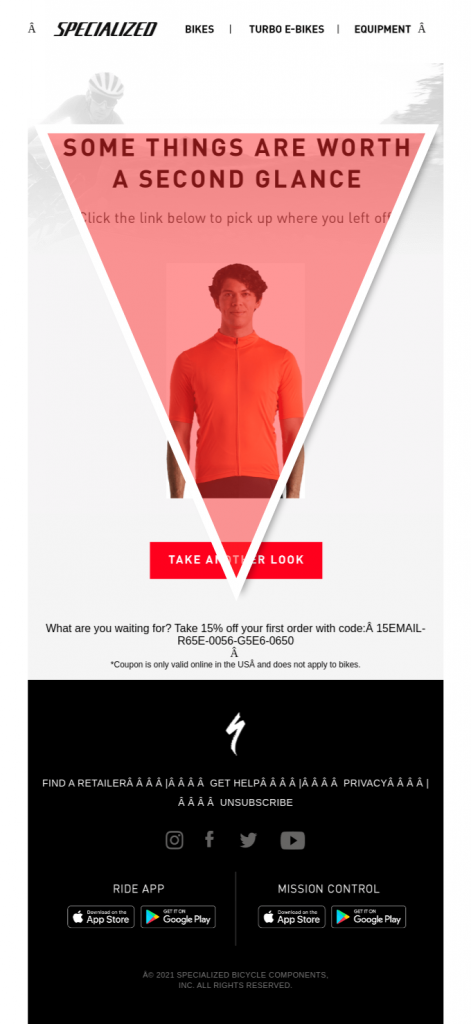
The design of the email marketing campaign is as important as the design of the website or any other corporate channel. All pieces are part of the whole that is the corporate image and contribute to the brand’s identity, recognition, and differentiation.
We tell you more: it is key to convert.
Designing an email is NOT about including pretty images that catch the eye. It’s above that.
- It must adapt to any screen/device (responsive design).
- Offers readable and striking texts.
- Makes the call to action clear.
- Identifies the brand at a glance.
- Indicates to the user what is expected of them quickly.
- Includes buttons, highlighted links, and graphic harmony between the different elements present in the email body.
- Has a good arrangement of elements (titles, text, columns, images, buttons…).
- Is harmonious in size and colors.
- Can include animations, videos, and other multimedia resources.
- Does not sacrifice effectiveness for art/design.
- Catches attention.
Want to have a base, see examples? Register on our platform and check out our templates.
Do you have any other questions? Leave them in the comments 👇🏽