Low Season Campaigns: How to Design Segmented Offers That Truly Convert
 Yacarlí Carreño · 07 Aug, 2026 · Digital Marketing · 11 min
Low season is not a demand problem. It’s a relevance problem. Mid-August, and yes — today we start strong.
There is a scene that repeats almost every year.
For some businesses, it’s a month like this one. For others, it’s January. Basically, it’s that time of year when sales start to slow down — and the feeling inside the company is always the same: “We have to do something, because this is slowing down.”
So the urgent meetings start. The team reviews last month’s figures, compares them to last year’s, and almost automatically, someone throws out the proposal that seems most obvious.
“What if we offer a discount?”
It’s an understandable reaction. When demand drops, lowering the price feels like the logical move. However, it rarely works the way we expect. Or, more precisely, it rarely works for long. As a strategy, it’s often not sustainable.
And when every brand responds the same way to the same problem, something else happens: they stop competing on value and start competing only on price. That’s a battle almost no one wins.
Low season doesn’t usually mean consumers disappear. In fact, people keep buying, keep researching, and keep making decisions. What actually changes is the context: priorities, timing, needs, and even how they perceive the value of an offer.
So that’s where many campaigns start to fail. It’s not because the product got worse, nor because the market disappeared, but simply because we keep communicating exactly the same way we did during high season.
What’s behind it? Thinking that all customers experience the same season

There is a deeply ingrained idea in many commercial strategies: assuming that the low season affects all customers equally.
However, just take a look at any database with some detail to see that this rarely happens.
While part of the audience reduces their purchase intention, another part continues to show interest. In fact, some users keep visiting the website frequently, while others open every email, even when they’re not yet ready to buy. There are customers who are simply waiting for the right moment to decide, and there are others who don’t even perceive it as low season, because their need remains the same.
So, why do we keep sending exactly the same campaign to everyone?
The answer is usually simple: because it’s easier.
But easy doesn’t always mean effective.
For years, we’ve talked about segmentation as if it were just another feature within any email marketing tool. Something almost purely technical. An option available in the menu. And, yet, it is increasingly evident that segmentation is not a feature. It’s a way of understanding people.
Rather than just separating contacts by age, city, or gender, segmentation means assuming that two customers who bought the same product can be at completely different stages in their relationship with the brand.
One might need a financial incentive. Another just needs to resolve one last doubt. Some will appreciate content that helps them get more out of what they’ve already bought… And another simply needs us to stop trying to sell to them for a few weeks (a break).
The difference seems small, but it completely changes the outcome of a campaign.
When price ceases to be the main argument
There is another quite common consequence during the low season: discount inflation (also applies to the sales period).
One brand offers 15%, the competition responds with 20. Another goes up to 25. And so, without us even realizing it, the whole conversation revolves around price.
The problem is that price is rarely the only reason a person buys.
For years, numerous consumer behavior studies have shown that factors far more complex than economic cost influence purchasing decisions. Trust in the brand, reduced perceived risk, ease of decision-making, or the feeling of receiving differential value — in many cases, these weigh as much as, or more than, the discount itself.
It’s not a perception. Personalization has become an expectation. According to a study by McKinsey & Company, 71% of consumers expect companies to offer personalized interactions, while 76% say they feel frustrated when that personalization does not exist. The conclusion is revealing: we are no longer talking about a differentiating element, but a standard that conditions the shopping experience.

Source: Unsplash
This data invites us to rethink a rather uncomfortable question: What if the problem is not that our offer is unattractive? What if the problem is that we are showing it to the wrong person or at the wrong time?
Because the same promotion can seem extraordinary to a customer who has been comparing options for months and completely irrelevant to someone who just made a purchase last week.
The difference is not in the discount. It’s in the context.
The best campaigns don’t sell more. They understand better.
When we look at the campaigns that truly work during periods of lower activity, an interesting pattern emerges: they are not necessarily the ones offering the greatest economic incentive; they are the ones that make the customer feel that the brand understands why they are receiving that message.
That small nuance completely changes the perception of a campaign.
It’s not the same to receive an email that says:
“20% discount for all our customers.”
As another that proposes:
“A few months ago you showed interest in this category, and we’ve prepared a selection designed precisely for this time of year.”
In both cases, there may be exactly the same discount, but the feeling is completely different.
If we look at the first example, the company talks about itself. In the second, it shows it has paid attention to the customer’s behavior.
And that difference is especially important during the low season, when attention is scarcer and tolerance for irrelevant messages decreases considerably.
Therefore, before asking ourselves what offer to launch, it might be worth asking a much more useful question:
What information do we really have about the people we are going to send it to?
Designing a good campaign doesn’t start with writing an attractive subject line or setting a discount percentage. Instead, it starts much earlier — with understanding that low season isn’t a problem to be solved with more promotions. Rather, it’s an opportunity to show that we know our customers better than our competitors do.
Segmentation is not about dividing a database. It’s about making better decisions.
Source: Unsplash
There is a curious trend in digital marketing. We constantly talk about segmentation and, yet, few of us stop to think about what segmenting really means:
- Segmenting is not about creating lists.
- Nor is it about separating customers based on the city they live in, their age, or the date they made their last purchase. All that can be useful, of course, but it’s still descriptive information. It tells us who the people are. It doesn’t tell us what they need now… And that difference is crucial when talking about low season campaigns.
Let’s think about an online store specializing in sports equipment. Two customers bought exactly the same shoes six months ago. From a traditional point of view, they might belong to the same segment. However, one has kept visiting the website every week, has opened almost every newsletter, and has checked the technical clothing category several times, while the other hasn’t interacted with the brand since the day of purchase.
Does it make sense to send them exactly the same offer? Probably not.
The first doesn’t need a reminder of who you are — they already have an active relationship with the brand. What they need instead is a proposal that fits the moment they’re in. The second, on the other hand, might not even remember why they decided to buy from you. So before offering a discount, it might be worth rebuilding trust first.
Before thinking about the offer, think about the intent
There is a question that rarely appears in meetings where commercial campaigns are prepared.
What is the customer trying to do/solve at this moment?
It seems like a simple question, it’s quite a traditional marketing question, but it remains key and completely changes the conversation.
Because not all users come to a company with the same intention or are in the same circumstance when they do. Some are discovering a need, others are comparing alternatives or seeking confirmation before making a decision. Others have already purchased and are simply waiting to feel accompanied or receive updates.
The problem is that many campaigns start from the opposite premise: they assume that all recipients are ready to buy immediately.
That explains why so many emails seem written for an imaginary customer who, in reality, doesn’t exist.
Google popularized the concept of micro-moments (we’ve talked about this in a previous article) years ago to describe those moments when a person turns to their device to solve an immediate need: learn something, find an answer, or make a decision. The underlying idea remains fully valid: when there is a clear intention, relevance depends as much on the content as on the moment it is offered. (Source: Think with Google, “Be there in micro-moments”).
Perhaps that is one of the most valuable lessons for any email marketing strategy: it’s not enough to send the right message, you have to send it when it can truly be useful.

Source: Unsplash
Email marketing stops being a broadcast channel to become a listening system
I believe this is one of the most interesting changes that email marketing has experienced in recent years.
For a long time, we understood newsletters as a loudspeaker, a tool to communicate promotions, launches, or news to an entire database.
Today that vision falls short.
Each opening, each click, each download, each purchase, and each period of inactivity generate valuable information about the moment a customer is in. And that information should condition the next conversation. That’s why it makes less and less sense to design campaigns thinking solely about the commercial calendar.
True planning begins by observing behavior.
It’s no coincidence that automation tools have evolved precisely in that direction. They no longer just schedule sends on a specific date. They allow you to build completely different journeys based on each user’s interaction.
A person might receive a product recommendation because they’ve visited a specific category several times in recent weeks, while another might enter a loyalty flow right after completing a purchase. In some cases, they may only be looking for educational content, simply because they’re not yet ready to decide. In reality, all these people are part of the same campaign, but none of them experience the same journey.
And probably that is one of the greatest competitive advantages that email marketing offers today compared to other channels: the ability to have different conversations with different people, without turning that complexity into an operational burden for the team.
Tools like Acumbamail precisely allow you to design this type of behavior-based automation, using dynamic segments and personalized flows that evolve as each contact does. It’s not just about saving time. It’s about avoiding all customers receiving the same message simply because it’s more convenient to manage.
Value is not always where we think
An offer is much more than a discount. In many cases, what reduces customer uncertainty is not paying less, but feeling that they are making a good decision.
That explains why some seemingly simple promotions work better than much more aggressive discounts:
- Early access to a new collection.
- A personalized session.
- Extended warranty.
- A selection of products tailored to purchase history.
- Practical guide to better utilize the contracted service.
All these proposals increase perceived value without needing to deteriorate the commercial margin.
And, furthermore, they have an additional advantage: they are much harder to copy.
Because any company can lower a price for a few days. What is really difficult is building enough knowledge about customers to offer exactly what each one perceives as valuable.

Source: Unsplash
That’s where segmentation stops being a technical issue and becomes a business strategy. This is often the true difference between campaigns that simply generate occasional sales and those that strengthen the customer relationship even during the quietest months of the year.
A real case: when personalization is worth more than the discount
There is a reason why some brands manage to maintain good commercial performance even when consumption slows down:
They don’t always sell cheaper. They simply know their customers better.
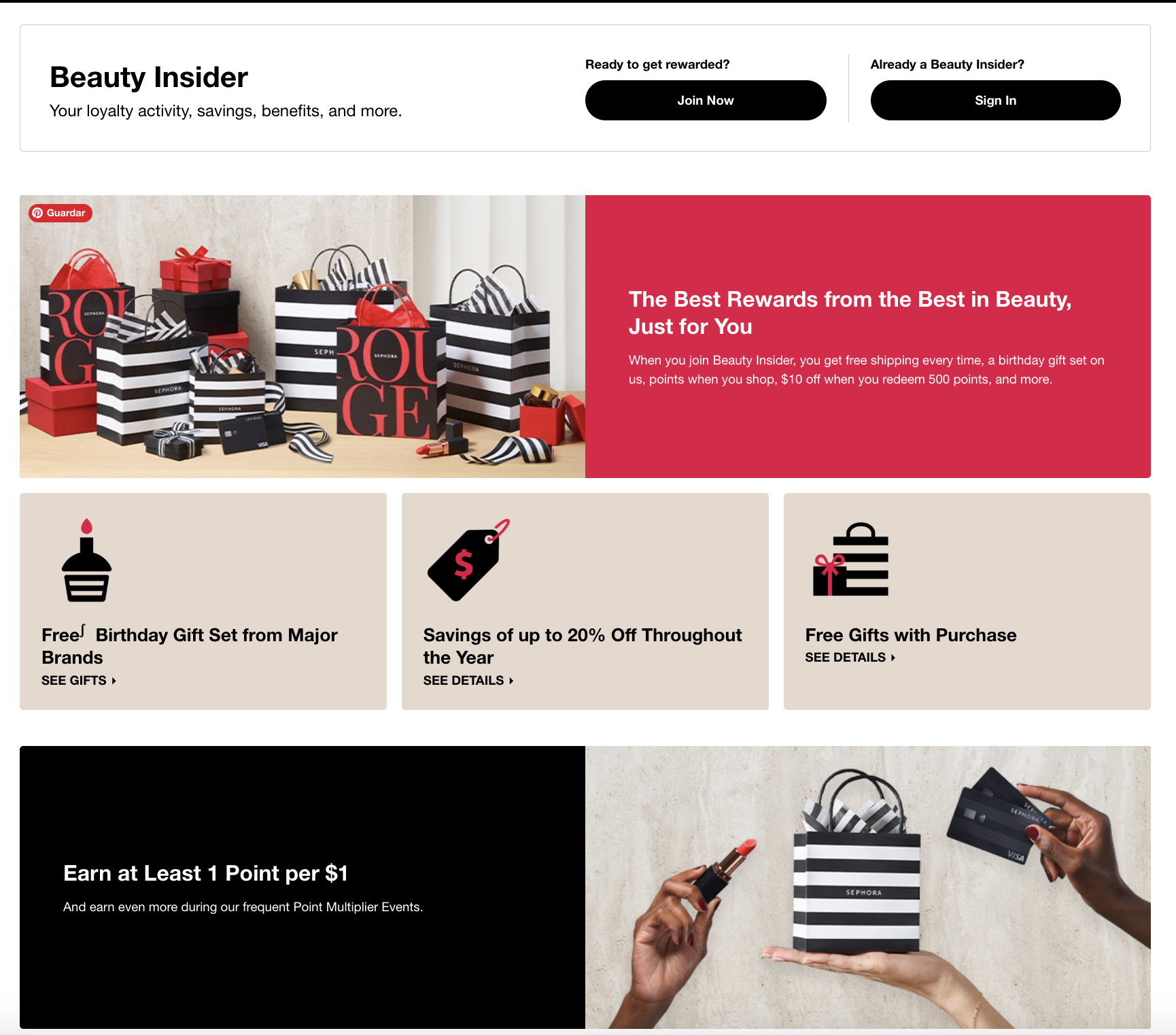
One interesting global example is Sephora. The company has been developing a personalization strategy based on customer behavior and information gathered through its Beauty Insider loyalty program for years, which has tens of millions of members worldwide.
But what’s truly interesting is not the size of the program, but the logic behind it.
Instead of limiting itself to sending massive promotions during periods of lower activity, Sephora adapts much of its communications according to variables such as purchase history, favorite categories, interaction frequency, or preferences declared by each user.
This means that two people can receive completely different campaigns on the same day. One might get recommendations related to products they regularly purchase. Another could receive educational content about a category they’ve recently started exploring. And a third might unlock exclusive benefits for belonging to a certain tier of the loyalty program.
Source: Sephora
The offer ceases to be generic. It starts to seem designed for each person, and that difference has a direct impact on the brand experience.
Because personalization is not just about writing the recipient’s name in the email subject; it’s about showing that the brand remembers who you are, what interests you, and where you are in the relationship.
Various analyses on customer strategy agree that one of Sephora’s strengths has been turning behavioral data into personalized experiences. McKinsey highlights how the company integrates information from in-store and online purchases, browsing, and the Beauty Insider loyalty program to offer recommendations and benefits tailored to each customer, thereby strengthening the long-term relationship. The learning is much broader than the beauty sector itself.
You don’t need millions of customers to apply this logic, you need to stop thinking about campaigns and start thinking about people.
The low season also serves to build the high season
There is a rather interesting paradox:
Companies usually dedicate most of their commercial efforts to the moments when it’s already relatively easy to sell:
- Christmas.
- Black Friday.
- Sales.
- Launches.
However, the quieter months offer something that the strong seasons almost never allow: time to strengthen the customer relationship.
- When advertising noise decreases, the space for generating more useful conversations increases.
- When the urgency to buy disappears, the opportunity to add value appears.
These differences have much deeper consequences than it seems… Because brands don’t build trust only when they sell; they build it, above all, when they demonstrate that they remain relevant even when they don’t need to sell immediately.
That’s why low season campaigns should pursue a slightly more ambitious goal than increasing monthly sales; they should help us answer a much more strategic question: What kind of relationship do we want to have with our customers when the high season returns?
If the only response we offer during the quiet months is a discount, we will probably be teaching the market to always expect a markdown.
If, on the other hand, we take advantage of that period to better understand our audience, offer useful content, personalize our communications, and build trust, the conversation will change completely.
We will no longer compete solely on price; we will compete on relevance.
For years, we’ve understood low season campaigns as a defensive tool, a way to maintain sales when the market slows down; perhaps it’s time to change that perspective.
A low season can also be the best time to experiment, learn, and strengthen what truly sustains any long-term marketing strategy: the relationship with customers.
Offers will continue to matter, and discounts will still make sense in certain contexts. However, they’ll hardly be enough if every competitor does exactly the same thing. The real difference won’t lie in who lowers the price more — it will lie in who understands the people on the other side of the screen bette
Low season campaigns should not only be measured by the sales they generate over a few weeks but also by the trust they will be able to build for the entire year.