Email Marketing for Ecommerce: Why No One Buys from Your Newsletter (Even If They Open It)
 Lucía Pérez · 31 Jul, 2026 · ecommerce · 7 min
To the new kings of online business, ecommerce, there is no doubt about one thing: email marketing for ecommerce is one of the most profitable sales tools available. And if not, tell us: do you know any successful ecommerce that doesn’t send newsletters? That’s why, in this article, we show you the keys to a good email marketing campaign to sell online. Take note!
There are businesses that only aim for their newsletter to be read and clicked on. Not here. We are going to focus on something more ambitious: the actual purchase by the user. For that, we are going to take a classic sales strategy and apply it to the world of email marketing for ecommerce.
The first obstacle of email marketing for ecommerce: getting the email opened
No matter how good your newsletter is inside. If no one opens it, it’s useless. The subject line is your showcase. And like any showcase, you have less than two seconds to catch that glance before the user continues scrolling through their inbox.
Many ecommerce businesses play it safe. They write subject lines like “July Newsletter” or “Weekly News.” And precisely because of that, they go unnoticed: they say nothing, promise nothing, give no reason to stop the finger.
Let’s see what does work.
Don’t promise what you won’t deliver. It’s tempting to write an explosive subject line to force the click. But if the content doesn’t live up to it, you lose something more valuable than a click: trust. And once that trust is broken, it takes many campaigns to regain it. So surprise, yes, but make sure what’s inside lives up to the expectation created.
Leave questions in the air. A subject line with ellipses, or that poses something without fully resolving it, triggers curiosity. The brain hates leaving stories unfinished. For example: “We forgot to tell you something about your order…” generates more openings than “Information about your order,” even if the content is the same.
Leverage what you already know about each customer. If you segment your database, use that information in the subject line. Imagine a women’s fashion store with a sale campaign on accessories. Instead of a generic subject (“Sales on accessories”), separate the customers who bought red dresses. Send them something like: “Remember that red dress? We have the perfect accessory.” That’s not magic: it’s having the right data at hand at the right time.
Numbers and urgency also work. “3 days until sizes M run out” communicates much more than “Last units available.” However, don’t invent false urgency: if the customer discovers that “2 units left” has been the case for three months, you lose credibility. Use real data.
A final tip before continuing: don’t stick with the first idea. Write three or four different subject lines. If your sending volume allows, test first with a part of your list and send the winning version to the rest. Over time, this gives you a real pattern of what works with your specific audience.
How to Build an Email Marketing Newsletter for Ecommerce That Sells
Once opened, the real work begins. This is where many ecommerce businesses fall short: they write a nice email, with good photos, but without any sales strategy behind it.
The key is simple, although few apply it: transfer to the newsletter what any good salesperson does in a physical store. That is, identify a customer’s problem and offer them the solution. It’s not enough to show them a catalog and expect them to decide on their own.
To see it better, let’s use a specific case. Imagine an online shoe store. We’ll call it Step Firm. It sells shoes, like hundreds of other ecommerce stores. But the difference between its newsletters selling or not lies in these four steps.
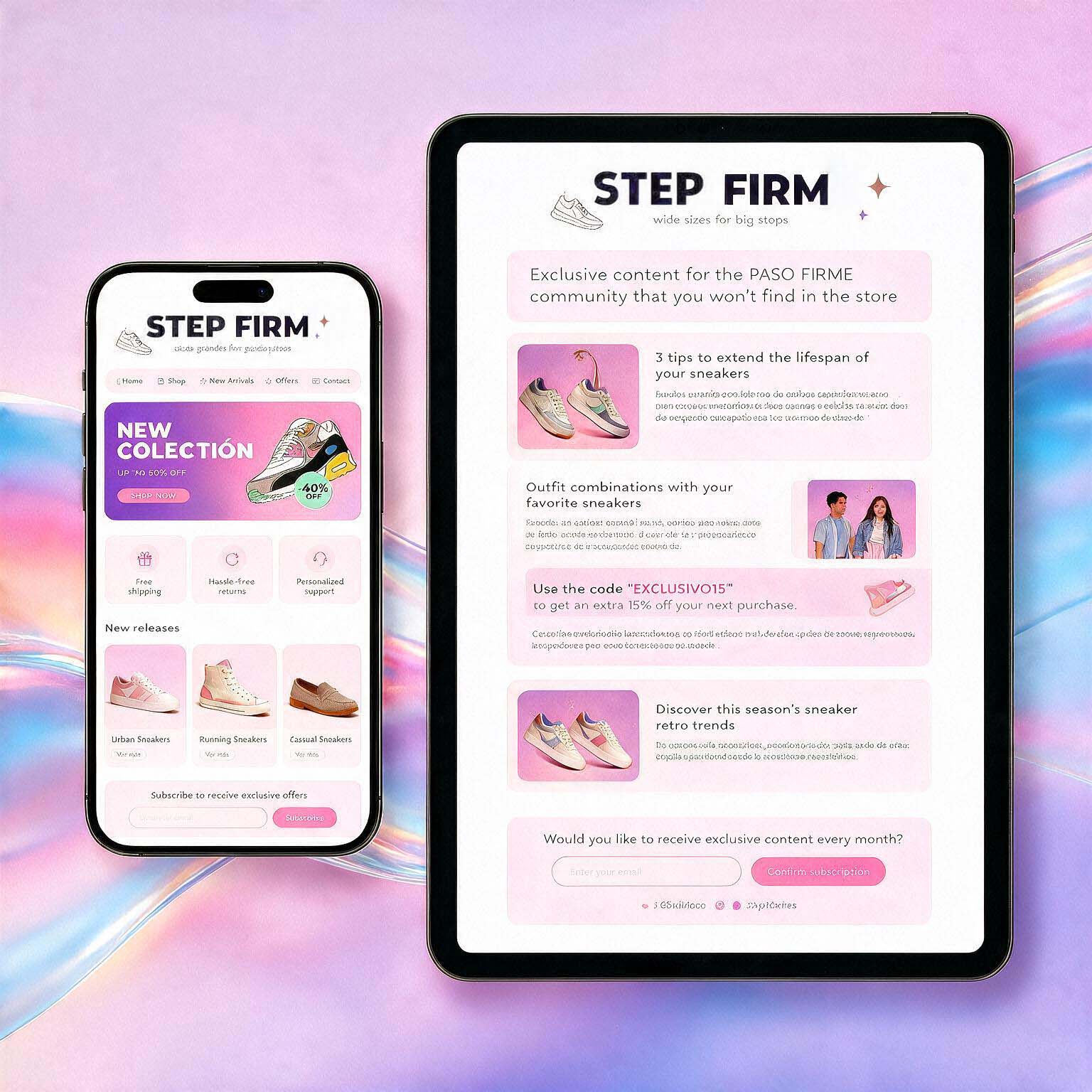
Visual generated by AI with Magnific as part of the creative content development.
1. Detect the Real Problem of Your Customer
Before writing a single line, you need to know what concerns the person who will read your email. You don’t need a market research department. You can launch a short survey in exchange for an incentive (discount, free shipping, early access). Then, group your customers according to the need they share.
In the case of Step Firm, the survey reveals something unexpected. A group of customers complains about not finding elegant shoes in large sizes. Another distinct group is looking for comfortable shoes for standing long hours. These are two different problems, so they need two different newsletters. This is where segmentation comes in: it makes no sense to send the same email to both groups.
2. Stand Out Without Fear
This is not the time to be shy. What makes your product better than the competition’s? It could be the price, the quality, or a very specific niche: sustainability, special sizes, local production. Or simply that you understand your customer better than anyone else in your sector. Whatever it is, say it clearly, without beating around the bush.
Step Firm could just say “we have shoes in large sizes.” Any competitor would say the same. But it can also be much more specific: “We design each model also in sizes 42 to 45, not as a separate line, but as part of the main collection.” That second version not only informs: it takes a stand. And that generates brand preference. Ambiguity doesn’t sell. Conviction does.
3. Put the Problem, and the Solution, Right in Front of Their Eyes
This is the heart of good email marketing for ecommerce: it’s not about showing products, but about demonstrating that you understand the customer’s need before they even have to explain it.
If the survey revealed customers frustrated by not finding elegant shoes in large sizes, don’t send “Seasonal News.” Send a selection made for them, with that problem named in the email itself. For example, with a headline like: “Finally, dress shoes in your size, without compromising on design.”
When someone feels like you’re speaking directly to them, and not to a generic list of 10,000 contacts, conversion almost rises on its own. This is where automation makes the difference compared to manual sending. You can set up a flow that, based on survey responses or browsing history, automatically sends the correct selection to each segment. Without creating twenty different newsletters by hand.
4. Don’t Leave Them Lost: Guide the Purchase
Imagine that customer in front of you in the store, trying on a model they love. You would never say “well, let me know” and stay silent. You can’t do that in an email either.
Every block of your newsletter needs a clear path to purchase. That means a visible button, not a text link lost at the end of a paragraph. It also means a CTA text that says exactly what will happen when clicked, like “View the collection in large sizes,” instead of a generic “More information.”
Additionally, there’s a detail that’s often forgotten: the landing page must continue the same conversation that started in the email. If you’re talking about shoes in large sizes and the click leads to the general homepage, you break the thread right at the decisive moment. The click should lead directly to that specific selection.
Visual generated by AI with Magnific as part of the creative content development.
Email Marketing Mistakes for Ecommerce That Are Costing You Sales
There are a series of mistakes that repeat over and over. And they almost always go unnoticed because the email “looks good” on the outside.
Sending the same content to the entire list. Without distinguishing between those who have already bought from you, those who haven’t opened anything for months, or those who just subscribed. A repeat customer and someone who doesn’t know your brand need different messages, even if you’re selling the same product.
Showing too much in a single email. Ten different products is not generosity: it’s indecision transferred to the customer. The more options you give, the easier it is for them not to choose any. A newsletter focused on a specific problem converts better than an entire catalog compressed into an email.
Forgetting about mobile. Most of your openings come from a phone. So, if your buy button is tiny or the email takes too long to load, you lose sales before the customer even gets to read your offer.
Not using automated emails in the customer lifecycle. Welcome, abandoned cart, inactive recovery, post-purchase follow-up. It’s not intuition, it’s a real industry pattern: a well-set-up cart recovery flow can add between 10% and 30% more revenue on the same traffic you already have, without spending an extra euro on advertising. And yet, many ecommerce businesses don’t even have this flow set up.
The Detail Almost Everyone Forgets: Emotion
You can have the perfect structure and still fail if the email sounds robotic. People don’t buy from a spreadsheet with photos. They buy when they connect with something: a resolved need, a story they identify with, the feeling that someone understands them.
That’s why, before approving a newsletter, read it out loud. Ask yourself if it sounds like one person telling another, or like a marketing department filling out a template. If it’s the latter, rewrite it.
Measure What Really Matters in Email Marketing for Ecommerce
The open rate tells you if your subject line worked. The CTR tells you if the content sparked enough interest to click. But if you sell online, the metric that really matters is another: the conversion rate of each campaign and the revenue generated per email sent.
You can have spectacular openings and mediocre sales. That usually means the problem isn’t in the subject line, but in what comes after: segmentation, messaging, or the path to purchase. Review these numbers campaign by campaign. That way, you stop guessing and start systematically repeating what really sells.
Put It Into Action
None of this is of much use if it remains theoretical. With Acumbamail, you can segment your database based on purchase behavior, automate sending at the right moment in the customer lifecycle, and measure which subjects and segments really work, instead of going blind.
The difference between a newsletter that gets read and one that sells isn’t luck. It’s in consistently applying this salesperson logic behind every email you send.
So the next time you sit down to write your newsletter, change the starting question. Instead of “What am I going to announce today?”, ask yourself “What problem am I going to solve today for the person who opens it?”. It’s a small nuance. But it’s exactly what separates an email that gets read from one that generates revenue.