Comprehensive Guide on Artificial Intelligence Agents: What They Are, How They Work, and How to Use Them
 Alicia Zunzunegui · 02 Mar, 2026 · Marketing Online · 7 min
Artificial Intelligence (AI) has transformed numerous aspects of our daily lives. But undoubtedly, AI agents are one of its most revolutionary functions. From virtual assistants that answer questions in real-time to advanced systems that make critical decisions in complex environments, AI agents are redefining how we interact with technology.
In this article, we will explore in depth what Artificial Intelligence agents are, how they work, the benefits they offer, practical applications, and best practices for implementing them.
If you want to understand how these systems can transform your projects or your business, keep reading.
Everything You Need to Know About Artificial Intelligence Agents
Artificial Intelligence (AI) agents are advanced programs designed to do three things:
- Interact with their environment
- Collect data from different sources
- Make decisions autonomously
Unlike traditional systems, which require explicit instructions for each action, AI agents can adapt, learn from their environment, and act independently to meet specific objectives.
Their main purpose is to solve complex problems or perform repetitive tasks with efficiency, precision, and speed. This makes them an essential tool for optimizing processes and reducing costs in a wide variety of sectors.
For example, an AI agent can manage customer service in a digital business through a chatbot, which analyzes frequently asked questions and responds immediately, improving the user experience while freeing up human resources for more strategic tasks. We will see some usage examples later.
Moreover, AI agents are not limited to performing specific tasks; they can also evolve thanks to the implementation of machine learning techniques (machine learning). This means that over time, they improve their performance by analyzing new situations and receiving feedback, adapting to changing needs.
You might be interested in: Types of Artificial Intelligence That Exist
Benefits of Using Artificial Intelligence Agents
AI agents provide significant advantages:
- Automation. They perform repetitive tasks without human intervention.
- Efficiency. They process large volumes of data quickly.
- Personalization. They adapt responses and actions according to user needs.
How Does an AI Agent Work?
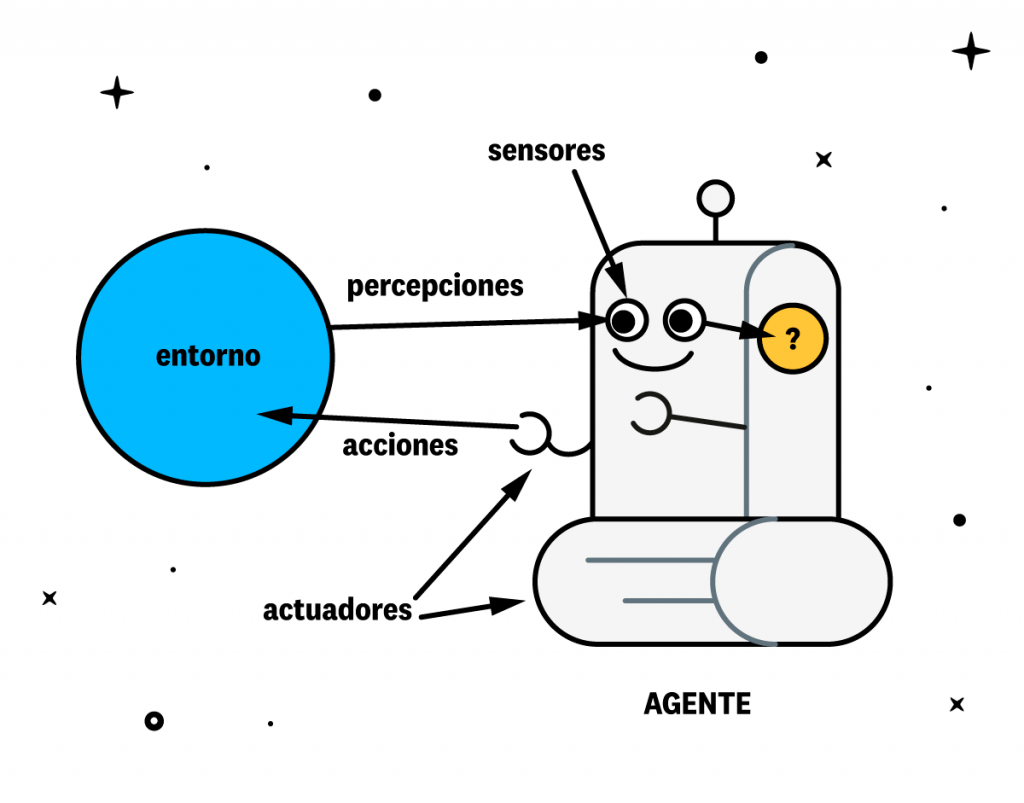
The functioning of Artificial Intelligence agents is based on the efficient interaction of three key components:
- Sensors
- Algorithms
- Actuators
1. Sensors
Sensors are responsible for collecting data from the environment. These can be as simple as a text field on a website where the user enters a query or as complex as cameras and microphones to capture images and sounds.
In a digital business, sensors translate into tools like forms, cookies, or data analysis systems that monitor user interactions.
2. Algorithms
Once the data is collected, algorithms are responsible for processing it and transforming it into decisions. These algorithms, which can include machine learning (machine learning) or natural language processing (NLP), analyze patterns, predict outcomes, and determine the best response or action.
For example, in a digital business, an algorithm can identify that a customer is interested in technology-related products based on their browsing history.
3. Actuators
This component executes the action defined by the algorithms. In the context of an AI agent, this can mean sending a personalized email, displaying product recommendations, or activating an automated support system.
Actuators often manifest as automated messages, adjustments in the user interface, or immediate responses in a chatbot.
Practical Example of a Digital Business Using AI Agents
Suppose you have a digital business that sells online courses.
Let’s look at a case where you could implement an AI agent to improve customer experience and increase sales.
1. Sensors
The system collects customer information through registration forms, clicks on specific categories of the course catalog, and time spent on product pages.
2. Algorithms
The data is processed to identify patterns, such as which topics are of greatest interest to a customer (e.g., digital marketing or graphic design).
The system uses a recommendation algorithm that suggests the most relevant courses for each customer, based on their interactions and those of similar users.
3. Actuators
Once the ideal course for the user is defined, the AI agent personalizes a message that is automatically sent via email or in a notification on the website, highlighting the advantages of the recommended course and including an exclusive discount.
What Is Achieved with This AI Agent?
The customer receives a personalized experience that increases the likelihood of conversion, while the business optimizes its time and resources by automating much of the process.
In this process, it is essential to have an email marketing strategy to send emails at the right time. Check out our guide to transactional emails.
Types of AI Agents: Which One Is Right for Your Goals?
There are several types of AI agents, each designed to address specific needs:
- Simple reflex agents. They respond to immediate stimuli without storing prior information.
- Model-based agents. They maintain an internal representation of the environment for more sophisticated decisions.
- Learning agents. They learn and improve their performance over time thanks to feedback.
Let’s look at them in more detail with examples.
Key Differences Between Simple Reflex, Model-Based, and Learning Agents
Artificial Intelligence agents are classified according to their complexity and ability to interact with their environment.
Understanding the differences between them is key to choosing the right solution based on the objectives of a digital business.
Simple Reflex Agents
These agents respond directly to environmental stimuli without storing prior information or performing complex analysis. They operate with predefined rules and are ideal for quick, predictable, and repetitive tasks.
Imagine an ecommerce that uses a simple reflex agent to display a pop-up notification when a customer adds a product to the cart but does not complete the purchase.
This agent simply detects an action (adding to the cart) and triggers an immediate response (displaying a reminder message).
Model-Based Agents
Model-based agents are more advanced as they maintain an internal representation of the environment that allows them to analyze situations, foresee consequences, and make informed decisions. They can handle more complex scenarios that require context and planning.
For example, an online course business uses a model-based agent to recommend content. This agent analyzes the user’s browsing and purchase history, builds a model of their preferences, and suggests relevant courses.
For instance, if a user shows interest in graphic design, the agent might suggest related advanced courses or promotional packages.
Learning Agents
These agents are the most advanced as they not only make decisions based on previous data but also learn and improve their performance over time through feedback. They use techniques like machine learning (machine learning) to adapt to changes in their environment.
Let’s consider an ecommerce that sells clothing. It could use a learning agent to personalize the customer experience. Initially, the agent analyzes each user’s searches and purchases, but as it collects more data (such as clicks on products, reviews, or returns), it adjusts its recommendations.
Over time, this agent can identify seasonal buying patterns or even predict which products will interest the customer most based on their history and current behavior.
| Type of Agent | Level of Complexity | Use Case |
| Simple reflex agent | Low | Display a pop-up message to complete a pending purchase. |
| Model-based agent | Medium | Create a personalized recommendation system based on user history. |
| Learning agent | High | Personalize the user's homepage with products they are likely to buy in the future. |
As you can see, having an AI agent is key if you want to offer extreme personalization in your business.
Real Applications of AI Agents in Daily Life
AI agents are present in numerous applications:
- Virtual assistants: Siri, Alexa, or Google Assistant.
- Autonomous vehicles: systems that process environmental data to drive safely.
- Chatbots: respond to queries on websites and social media.
Use Case in Customer Service
Let’s look at a use case of how an AI agent applies to customer service automation.
An e-commerce platform faces the challenge of handling thousands of daily customer inquiries about order status, returns, and product questions.
The volume is so high that the human team cannot address them all as quickly as customers expect, affecting satisfaction and conversion rates.
How can it be solved with AI?
An Artificial Intelligence agent based on machine learning is implemented to manage customer service.
This agent is deployed on two main channels: a chatbot on the website and an assistant integrated into a mobile app.
Functioning:
- Data collection (sensors). The agent collects information directly from users through forms, natural language questions, and historical account data.
- Analysis and decision-making (algorithms). It uses a natural language processing (NLP) model to interpret customer questions and query the order or product database. It can also identify complex queries and automatically redirect them to a human agent.
- Execution (actuators). It provides immediate answers to common questions, such as “When will my order arrive?” or “How can I make a return?” and even guides users step-by-step through the process.
Results the business can expect:
- Reduced response time. Common queries are resolved in less than 3 seconds.
- Increased customer satisfaction. The speed and accuracy of responses improve the user experience, leading to greater loyalty.
- Team optimization. AI agents handle 80% of routine queries, allowing the human team to focus on solving more complex problems.
- Increased conversions. The agent can also recommend related products based on customer queries, increasing the average purchase ticket.
Thanks to the AI agent, the platform manages to scale its customer service without needing to hire more staff, optimizing costs and offering a more agile experience to its users.
Best Practices for Effectively Implementing AI Agents
To get the most out of AI agents, it is crucial to follow best practices:
- Define clear objectives. Establish what you want to achieve with the agent.
- Choose the right type. Consider the specific needs of the project.
- Ensure ethics. Avoid biases and prioritize transparency.
On this last point, I would like to elaborate a bit more.
How to Ensure Success and Ethics in the Use of Artificial Intelligence Agents?
The success and ethics in the use of AI agents depend on a careful design and constant supervision.
To ensure their effectiveness, it is essential to train them with representative and quality data, eliminating possible biases that may influence their behavior. This ensures that decisions are accurate and appropriate to the environment in which they operate.
Active supervision is key to evaluating their performance and detecting possible deviations, allowing adjustments before they cause negative impacts.
Additionally, establishing a clear ethical framework that prioritizes transparency and defines the limits of the agent’s capabilities ensures that their actions align with the project’s values.
Do not forget that encouraging user feedback helps identify areas for improvement and adjust the system according to real needs, achieving a balance between efficiency and ethical responsibility.
To Conclude
Artificial Intelligence agents are transforming the way we interact with technology. From their basic functioning to their practical applications, understanding this topic will allow you to identify opportunities to improve your projects and optimize processes.
Now is the time to reflect on how AI agents can benefit your initiatives. Are you ready to explore them?