Kickstart 2026 with Smart Automations: How to Create Welcome and Re‑engagement Flows with Acumbamail
 Yacarlí Carreño · 14 May, 2026 · Email marketing avanzado · 6 min
Discover how to create smart automations in Acumbamail for welcome and re‑engagement flows that increase your audience’s engagement and the coveted conversions in 2026 with practical examples and key data.
By now, automation in email marketing has ceased to be a competitive advantage and has become a fundamental strategy for any brand that wants to connect with its audience efficiently, personally, and scalably. Smart automations, such as welcome flows and re‑engagement flows, are key pieces to accompany the user from the first contact to their reactivation when they stop interacting with your communications.
The data backs it up: welcome emails have open rates that can exceed 60–70%, far above the average of standard campaigns, demonstrating their effectiveness in generating engagement from the very first moment. This is highlighted by Maria Laura Barreto in her article in Doppler full of interesting email marketing statistics.
In this article, I explain what these flows are, why they are essential in your email marketing strategy in 2026, and how to create each one step by step with Acumbamail, making the most of its automation capabilities.
What are smart automations in email marketing?
Email marketing automation is a set of rules that allow sending emails automatically and personally according to the behavior or characteristics of each subscriber (You can read more also in this article). This means that instead of sending the same message to your entire list, you can trigger emails based on events such as:
- When someone subscribes to your list.
- When a subscriber has been inactive for a while.
- When they perform a certain action (for example, download a resource).
This approach is essential because it allows:
- Saving time and resources, by not manually managing each send.
- Multiplying the effectiveness of your communications, by sending the right message at the right time.
- Personalizing the user experience, increasing the likelihood of opens, clicks, and final action.
Moreover, platforms like ours integrate native tools to easily design automatic flows from their control panel with visual logic, segmentation rules, and condition-based sending.
👉 If you want to understand how this works in practice, you can check how to create an automation step by step in the official support of our tool:🔗 How to create automations.🔗 How to create an autoresponder campaign.
Why welcome flows are important in 2026
Welcome flows are sequences of emails that are automatically sent to new subscribers from the moment they subscribe to your list.
Why are they so crucial?
1. They generate high open and engagement rates
Welcome emails have performance figures far superior to other campaigns. According to recent studies:
- They have open rates that can exceed 60–70%, even reaching much higher figures in some cases.
- Click and conversion rates also far exceed those of conventional manual sends. (More in EmailToolTester)
It’s intuitive: when someone subscribes, they are more receptive to receiving information. If you don’t take advantage of that moment, you may lose an invaluable opportunity for impact.
2. They set expectations and build trust
A good welcome flow is not just a “thank you for subscribing.” It serves to:
- Introduce your brand and values.
- Explain what type of content they will receive.
- Show what benefits they will get as subscribers.
This builds trust from the first contact, which is key for long-term loyalty.

3. They improve the user experience
Automating these sends with Acumbamail allows each new subscriber to receive a personalized and sequential message, without you having to do it manually each time.
Example of an effective welcome flow (with Acumbamail)
Before seeing the implementation, let’s look at an example of a structure that works:
- Email 1: Immediate welcome
- Email 2: Introduction of content and value
- Email 3: CTA or incentive
- Email 4: Segmentation based on behavior
This type of flow can be automatically sent in Acumbamail using the visual automation tool, where you define triggers, conditions, and messages. Acumbamail’s support details how to set up these automations visually on their platform. 🔗 Create automations in Acumbamail.
In the article we provided above, you will find the complete step-by-step guide to create this automation.
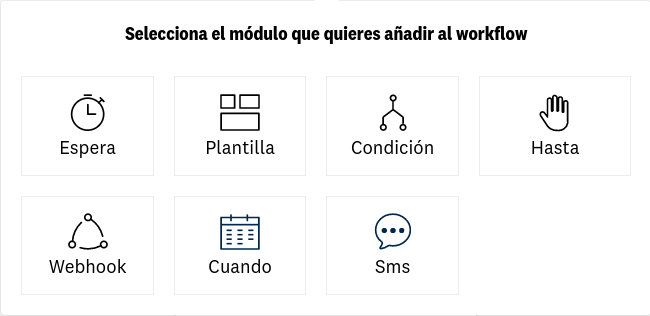
This module allows you to define a waiting period between an initial condition (such as, in this case, a subscriber joining your list) and the action that will be executed next within the automated flow, such as sending a welcome campaign or another defined action.
There are two types of waits: fixed and variable.
The fixed wait makes all subscribers remain the same time before advancing in the flow (for example, 2 minutes, 3 hours, or 4 days).
The variable wait, on the other hand, keeps the subscriber on hold until a specific day, and the duration will depend on when they entered the flow. This type of wait can be set according to a day of the week or a day of the month.
What are re‑engagement flows and why you need them
A re‑engagement flow or reactivation flow is designed to “recover” subscribers who have not interacted with your sends for a while. It is a strategic piece to prevent your list from losing health and your open metrics from dropping.
Why is reactivation important?
- “Cold” lists can reduce the overall deliverability of your campaigns.
- An inactive subscriber can re-engage if they receive the right stimulus.
- Re-engaging a subscriber usually costs less than acquiring a new one.
Performance data shows that re‑engagement automation can have significant impacts on key metrics (opens, clicks, and conversions) if done strategically.

How to design a re‑engagement flow in Acumbamail
Unlike the welcome flow, which is based on a clear event (subscription), the re‑engagement flow is based on inactivity conditions.
Conceptual step-by-step:
- Segment your inactive audience
- Set up the trigger
- Send a re‑engagement email 1
- Interaction evaluation
- Last attempt and cleanup
A much more valuable list is an active and optimized one than a huge list full of contacts that only lower the effectiveness of your marketing actions.
How to do it?
In the same article on how to do automations with Acumbamail, you have the step-by-step guide. Basically, you will need to select one of the following values: Opens Campaign, does not open campaign, clicks (on any link within the email), does not click, and whether that value has been met or not. In this way, you will establish the criterion by which of the two branches (YES or NO) the subscriber should continue through the flow.
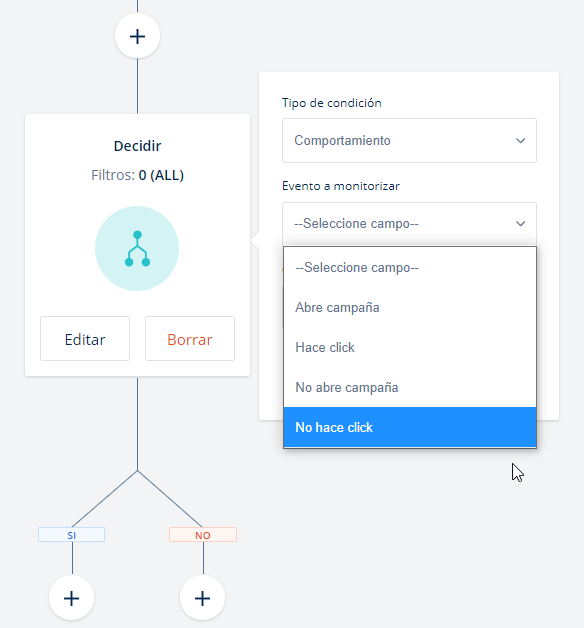
One of the advantages of using our platform is that it is very intuitive. Try it, and you’ll see that it’s very easy to follow the steps until you create your own campaigns and automations.
Key metrics to evaluate your automations
When automating welcome and re‑engagement flows, measure these KPIs to evaluate their success:
- Open rate (especially high in welcome).
- CTR (Click through rate).
- Conversions attributable to the flow (sales, downloads, subscriptions).
- Active list growth rate.
Remember that while open rates are still useful, clicks and conversions are more reliable metrics to assess the true impact of your automations.
Best practices to improve your automations in 2026
- Always segment your audience. Not all subscribers are the same. Even if you think your list isn’t big enough, it doesn’t matter. Seriously, it’s much better to have a small but well-segmented list. We promise it will respond much better.
- Use behavioral data. The more relevant your messages are, the better results you’ll get. Measuring is sometimes uncomfortable, but it’s necessary. It’s the key to ensuring the sustainability of digital marketing actions, the foundation.
- Maintain a consistent frequency. Neither too few sends that they forget about you, nor too many that overwhelm. Time and practice will help you find the ideal.
- Personalize from the subject to the CTA to reinforce engagement in each email.
- Test and continuously optimize. Test different assumptions, content, and sequences to find what works best.
Conclusion
Starting 2026 with smart automations is not a trend: it is a strategic necessity for any business that wants to maximize the value of its mailing lists and improve engagement and conversion metrics.
With welcome flows, you capture your subscribers’ attention when they are most receptive. With re‑engagement flows, you recover inactive users and keep your list healthy and active.
And the best part: with Acumbamail, you can set up both types of automation without complications, from an intuitive interface that transforms rules and events into automatic communications that work for you and with you.