Design Thinking: What Exactly Is It and How Can It Help You?
 Rocío Cortázar · 12 Feb, 2026 · Diseño Gráfico · 4 min

Nowadays, it is key to stand out, and in many cases, traditional methodologies are not enough to find effective solutions. In these cases, we can use design thinking to achieve a people-centered approach that solves problems in an innovative way by combining creativity, analysis, and experimentation.
This methodology is not limited to designers only; companies, entrepreneurs, and groups from various industries are incorporating it to optimize products, services, and experiences.
What is Design Thinking?
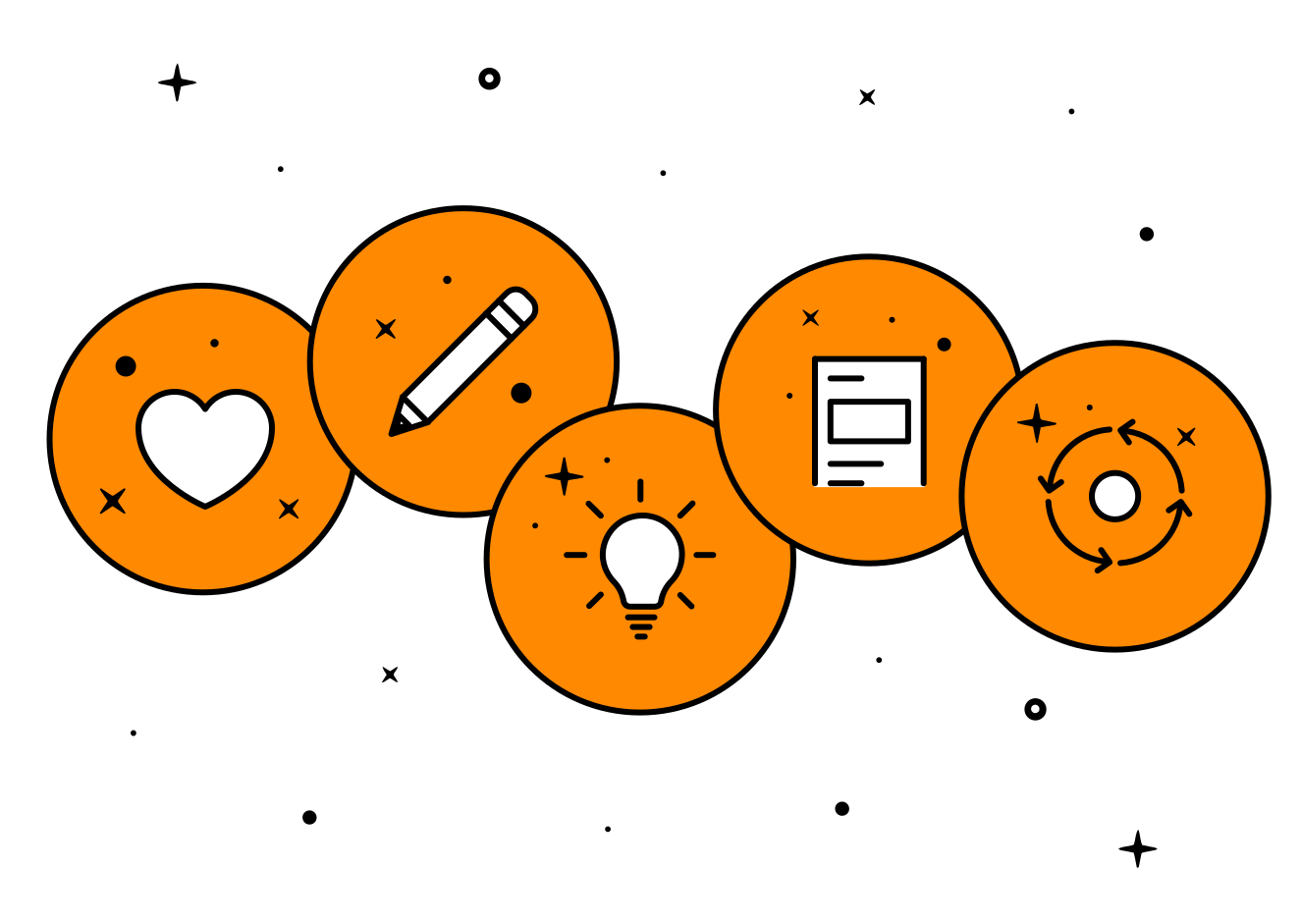
Design thinking is a process that helps teams develop their creativity. Design thinking emphasizes creativity, cooperation, and experimentation to create innovative solutions. It focuses on understanding and empathizing with people, resulting in the creation of products, services, or processes that offer real value. It integrates observation, ideation, prototype development, and continuous validation as part of an iterative process, with flexibility and adaptability as key points in the search for answers. Typically, multidisciplinary work teams are formed to implement it, bringing diverse ideas.
Although it may seem like a recent concept, its origins date back to the mid-20th century, when experts in design and architecture began applying a more structured approach to problem-solving. The first to use this term was Herbert Simon (Nobel Prize in Economics) in his book The Sciences of the Artificial. But this term was forgotten until the 1990s, when IDEO, a design firm, popularized the term and turned it into a methodology applicable to multiple industries. Since then, design thinking has become a key tool for fostering innovation in all types of organizations.
Advantages
- It fosters innovation.
- It focuses on the needs of the user.
- It promotes multidisciplinary collaboration.
- It provides an iterative approach to problem-solving.
Disadvantages
- Need for time.
- Resources are needed for proper implementation.
- Possibility of biases in the empathy process.
- Difficulty in measuring the success of generated solutions.
How Design Thinking Can Help You
To succeed, it is essential to understand your client’s needs and create innovative solutions that meet them. Design thinking can help you reach these solutions and much more:
- Observe your target audience in depth and empathize with their needs and preferences.
- Focus on people. We often try to solve problems from a purely technical perspective; design thinking helps us reinterpret problems from a human point of view.
- Greater involvement. It ensures that teams are much more involved in the creation, prototyping, and testing processes.
- Simplifies processes. It helps find ways to tackle complex problems by breaking down the steps to follow.
- Mediate between diverse visions. It’s normal for different visions to arise in a project; design thinking helps find balance and commitment among different viewpoints.
- Better user experience. By focusing on people, interactions between the user and the product are optimized.

Characteristics of Design Thinking
- The user is the priority As we have explained, the heart of design thinking is undoubtedly the user. The entire process revolves around understanding their needs, emotions, and problems to create something that truly serves them.
- Makes innovation dynamic and fun Far from being a rigid methodology, design thinking turns innovation into an agile, flexible, and stimulating process. It relies on creative tools and constant interaction between teams and users, making the path to the solution more of an exploration game than a list of mandatory steps. Each project is different, and that means the dynamics can also be adjusted according to what works best in each case.
- Fosters collaboration instead of competition Working in a team can be chaotic, but design thinking seeks to have each person contribute their perspective without fear of their idea being immediately discarded. Instead of competing for who has the best proposal, it’s about building together, leveraging everyone’s strengths to find the best solution. Each idea is analyzed, improved, or transformed into something even more valuable.
- Boosts curiosity and creativity Creativity is not exclusive to artists or designers. Everyone has the ability to think innovatively, whether it’s solving a technical problem, finding a shortcut in the daily routine, or even improvising a recipe with what’s left in the fridge. Design thinking starts from that innate curiosity, promoting constant questions and experimentation to reach solutions we might never have imagined.
- Accepts error as part of the process It’s not about getting everything perfect the first time. Failing is not only normal but a fundamental part of learning. Design thinking allows you to test, adjust, and repeat as many times as necessary until you find the best solution. Each iteration is an opportunity to improve, eliminate errors, and explore new paths without fear of failure.
Undoubtedly, design thinking has become a key tool for those seeking creative and effective solutions. Its people-centered approach, flexibility, and ability to foster collaboration make it ideal for any industry or team wanting to transform ideas into valuable products and services. More than a methodology, it is a way of thinking and approaching challenges with curiosity, empathy, and a willingness to learn.