
The 10 Essential Metrics to Measure and Scale Your Business Profitably
 Pablo Díaz · 06 Mar, 2026 · Marketing Online · 6 min

Many businesses sell. Some even grow. But growing in revenue doesn’t always mean growing in profitability. The problem usually isn’t a lack of effort or investment, but a lack of clarity about which numbers truly determine the health of your business.
Investing in advertising without controlling the CAC, celebrating revenue without analyzing the margin, or scaling campaigns without looking at the LTV are some mistakes many people make. They don’t happen due to a lack of work, but due to a lack of system. And that system starts by understanding which metrics are truly strategic.
In this article, you will see the 10 essential metrics you must monitor if you want to make informed decisions.
We will organize them into four blocks: acquisition, conversion, profitability, and sustainability.
Let’s get to it.
What Makes a Metric Strategic?
A strategic metric is one that impacts cash flow, margin, or sustainability directly or indirectly. It’s not about measuring for the sake of measuring. It’s about measuring what affects decisions.
A metric is strategic when:
- It is aligned with a business objective
- It affects revenue, costs, or profitability
- It allows you to act on it
With that foundation, let’s move on to the key metrics.
Acquisition Metrics: How Much It Costs to Attract Traffic and Leads
1. CPC (Cost Per Click)
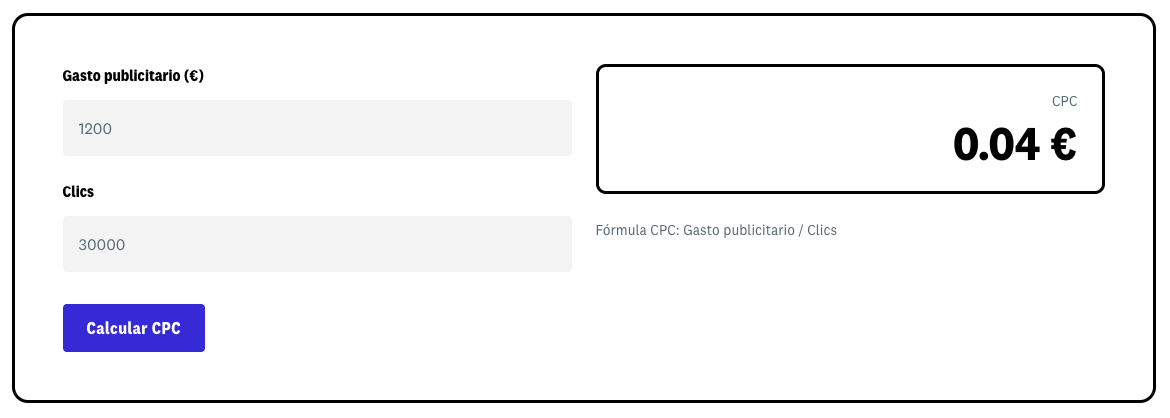
The CPC measures how much you pay for each click your ad receives. It is a basic metric of advertising efficiency. It indicates how much it costs to generate traffic to your website or landing.
How is it calculated?
CPC = Advertising investment / Number of clicks
For example: if you invest €1,000 and get 2,000 clicks:
CPC = 1,000 / 2,000 = €0.50
A low CPC means that traffic is cheap. But it doesn’t tell you if that traffic is qualified or if it converts. That’s why it should be analyzed along with the conversion rate and CPL.
CPC Calculator (Cost Per Click)
2. CPM (Cost Per Thousand Impressions)
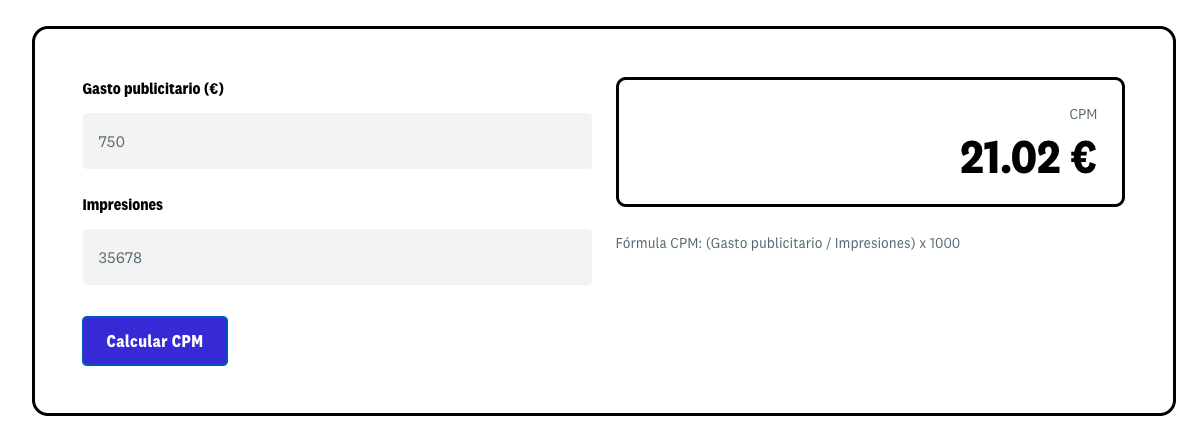
The CPM measures how much you pay for every thousand times your ad is shown. It is a cost-per-visibility metric.
It is calculated as follows:
CPM = (Investment / Number of impressions) × 1,000
If you invest €500 and get 100,000 impressions:
CPM = (500 / 100,000) × 1,000 = €5
The CPM is especially relevant in reach or branding campaigns. A high CPM may indicate high competition in the audience. But by itself, it does not measure commercial performance.
CPM Calculator (Cost Per Thousand Impressions)
3. CTR (Click Through Rate)
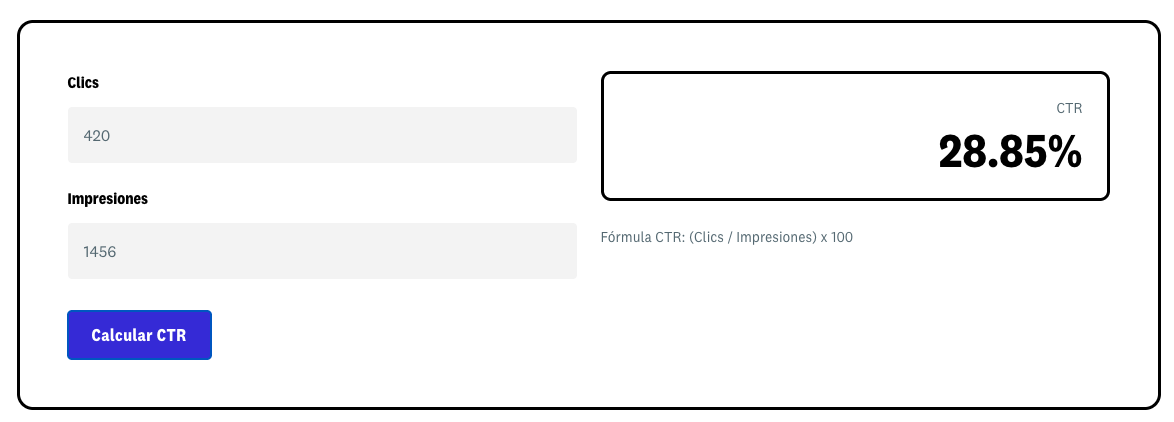
The Click Through Rate measures the percentage of people who click after seeing your ad. It is an indicator of the relevance and attractiveness of the message.
How is it calculated?
CTR = (Number of clicks / Number of impressions) × 100
If you have 2,000 clicks and 100,000 impressions:
CTR = (2,000 / 100,000) × 100 = 2%
A high CTR indicates that the ad connects with the audience. A low CTR may indicate poor segmentation or ineffective creativity. But a high CTR does not guarantee sales if the subsequent proposal does not convert.
CTR Calculator (Click Through Rate)
The CTR is a very present metric in email marketing campaigns. Here’s an article to learn about the most important ones.
4. CPL (Cost Per Lead)
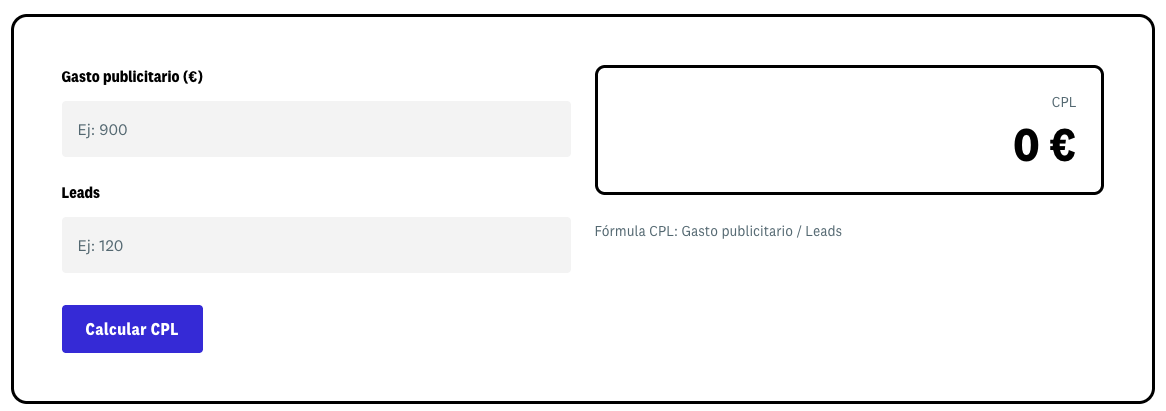
The CPL measures how much it costs you to generate an interested contact. We’re not just talking about clicks, but about people who leave their data or register.
The formula is as follows:
CPL = Advertising investment / Number of leads
If you invest €1,000 and get 200 leads:
CPL = 1,000 / 200 = €5
The CPL brings the metric closer to the real business. However, a high CPL can be perfectly profitable if the subsequent conversion rate and LTV compensate for it.
CPL Calculator (Cost Per Lead)
Do you want to generate more leads? I bet you do. Check out this article.
Conversion Metrics: Where Monetization is Decided
5. Conversion Rate
The conversion rate measures what percentage of users who enter your funnel end up buying.
It is one of the most influential metrics in profitability.
How is it calculated?
Conversion Rate = (Number of sales / Number of visits or leads) × 100
If you have 200 leads and 20 buy:
Conversion = (20 / 200) × 100 = 10%
Improving conversion has a multiplier effect. With the same traffic, you can generate more revenue. It is more efficient to optimize conversion than to increase investment.
One aspect that affects the conversion rate is the copy of the call to action or CTA, we talk more about it here.
6. Average Ticket
The average ticket indicates how much your business earns per sale made. It reflects the average value of each transaction.
A higher average ticket allows better absorption of acquisition costs. Small improvements here can significantly increase the margin without changing traffic.
Profitability Metrics: The Filter That Separates Growth from Illusion
7. CAC (Customer Acquisition Cost)
The CAC measures how much it costs to acquire a real customer, including all marketing and sales costs.
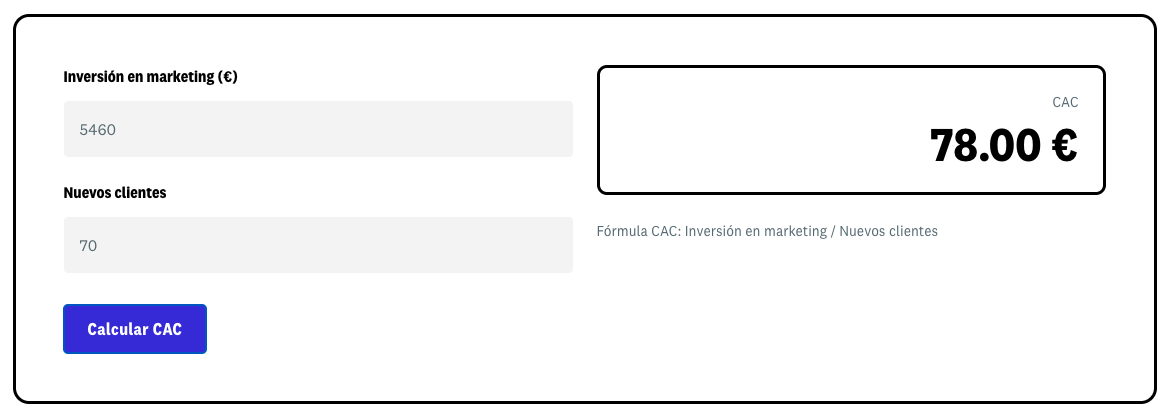
Its formula is as follows:
CAC = Total marketing and sales cost / Number of new customers
If you invest €5,000 in marketing and get 100 customers:
CAC = 5,000 / 100 = €50
The CAC is a structural metric. If it exceeds the value generated by the customer, the model is unsustainable. That’s why it should be compared with the LTV (we’ll talk about it below).
CAC Calculator (Customer Acquisition Cost)
8. ROAS (Return on Ad Spend)
The ROAS measures the direct return generated by the advertising investment.
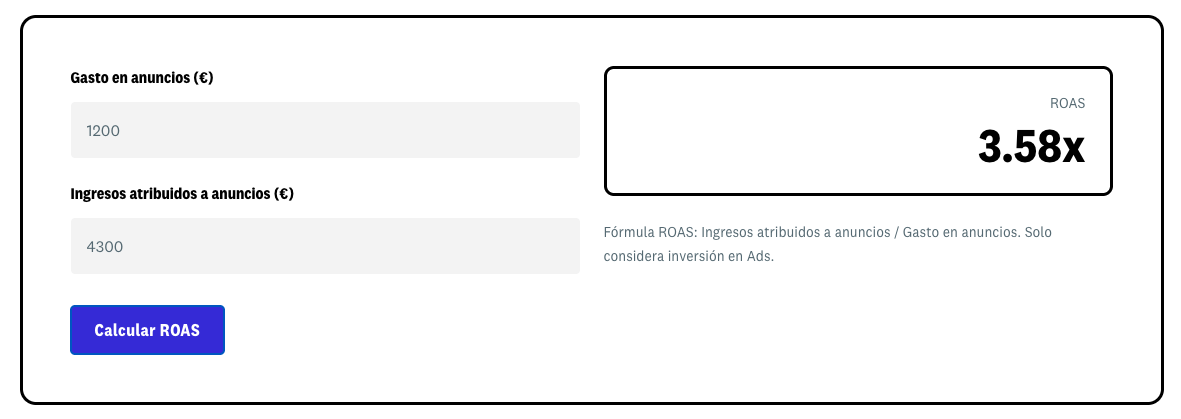
Its calculation is simple:
ROAS = Revenue attributed to advertising / Advertising investment
If you invest €2,000 in ads and generate €8,000:
ROAS = 8,000 / 2,000 = 4
A ROAS of 4 means you generate four euros for every euro invested. However, it does not consider operational costs or margin. An apparently high ROAS may not be profitable if margins are low.
ROAS Calculator (Return on Ad Spend)
Sustainability Metrics: Thinking Long Term
9. Life Time Value (LTV)
The LTV or customer lifetime value estimates how much money a customer generates during their entire relationship with your business. It is a key metric to determine how much you can invest in acquisition.
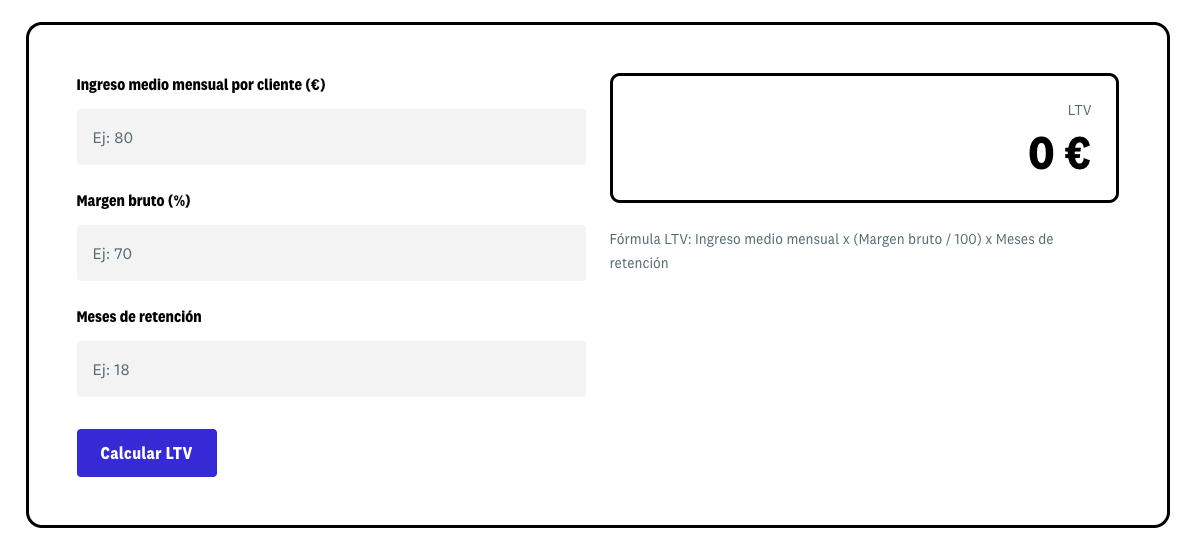
Its simplified formula is:
LTV = Average ticket × Purchase frequency × Retention time
If the average ticket is €100, the customer buys 3 times a year, and stays for 2 years:
LTV = 100 × 3 × 2 = €600
The higher the LTV, the greater your strategic margin to scale acquisition.
LTV Calculator (Life Time Value)
10. LTV / CAC Ratio
This ratio compares what a customer is worth with what it costs to acquire them. It is one of the most relevant indicators for evaluating scalability.
How is this ratio calculated?
LTV / CAC Ratio = LTV / CAC
If LTV = €600 and CAC = €50:
Ratio = 600 / 50 = 12
A ratio below 1 implies losses. A ratio between 3 and 5 is usually considered balanced and healthy.
Complementary Metric: Churn
The churn rate measures the percentage of customers who leave in a given period.
It directly impacts the LTV.
Its formula is:
Churn = (Lost customers / Customers at the start of the period) × 100
If you start the month with 500 customers and lose 25:
Churn = (25 / 500) × 100 = 5%
Reducing churn increases the LTV and automatically improves the efficiency of the entire system.
It is a very present metric in subscription or SaaS businesses.
Turning Metrics into Decisions
Metrics should not live in a decorative dashboard with your corporate colors.
They should form a system:
Acquisition → Conversion → Profitability → Value
If you improve CPC but conversion worsens, the system breaks.
If you have good ROAS but low LTV, growth is not sustainable.
If churn increases, the effective CAC skyrockets.
The key is not to measure more. It’s to measure what matters and analyze it in an integrated way.
Measure Well to Grow Better
Healthy growth doesn’t just depend on selling more. It depends on understanding how much it costs to grow, how much margin each customer leaves, and how much value they generate over time.
To summarize the metrics we’ve mentioned:
👉 CPC, CPM, CTR, and CPL tell you how much it costs to attract attention.
👉 Conversion and average ticket tell you how much you monetize that attention.
👉 CAC and ROAS tell you if your investment is efficient.
👉 LTV and LTV/CAC tell you if your business is scalable.
When these metrics work together, you have control. When analyzed in isolation, you have the illusion of control.
The difference between growing and scaling lies in that integration.