
What is Total Addressable Market (TAM) and How to Calculate Your Real Market
 Lucía Pérez · 22 Apr, 2026 · Marketing Online · 6 min
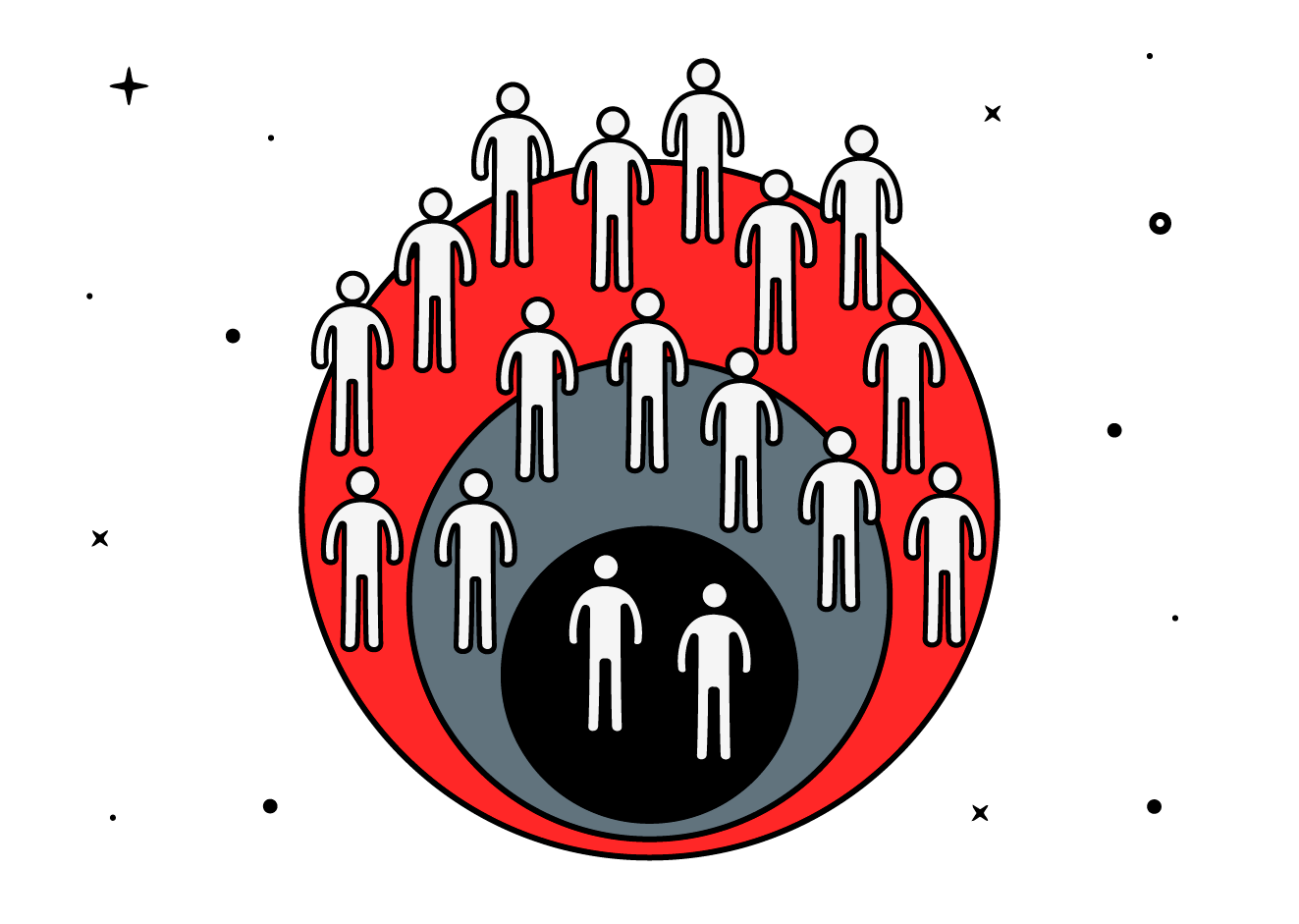
Before launching a product, opening a new market, or seeking investment, there’s a question you should answer: how much business is really out there for what you offer?
Most businesses answer that question vaguely. They cite the size of their sector (for example: “the ecommerce market moves billions annually”), mention the problem they solve as if that were synonymous with opportunity, or simply have never calculated it. The result is the same in all cases: poorly calibrated decisions, unrealistic goals, and investment directed in the wrong direction.
TAM (Total Addressable Market) is the number that brings order. It tells you the real ceiling of your opportunity before spending a euro. It’s not just a data point for the pitch deck: it’s a strategic compass that helps prioritize markets, decide if a product makes sense, and keep the entire team aligned with the same reference.
What is TAM (and what is it not)?
TAM is the maximum revenue potential your product or service could generate if you captured 100% of your possible customers.
In other words: if you sold to everyone who could buy from you, how much would you bill?
That definition seems simple, but it hides two very common mistakes.
The first is confusing the size of the problem with the market.
A company developing software to combat absenteeism might say: “absenteeism costs Spanish companies 3 billion a year, that’s our TAM.”
No. That’s the size of the problem, not the market they can reach.
Their real TAM is how much companies would pay for their specific solution, multiplied by how many could buy it.
The second mistake is using the industry’s entire TAM as if it were their own.
A company that manufactures ski visors doesn’t have the entire ski and snowboard market as their TAM. Their TAM is the potential buyers of visors specifically. It seems obvious, but this type of confusion appears more frequently than one might expect.
An important nuance: TAM is not a fixed number. It changes over time, with geographic expansion, new customer segments, or price adjustments. It should be treated as a living reference, not a number set in stone.
TAM, SAM, and SOM: Three Figures to Understand Where You Are
TAM only tells half the story. To make useful decisions, it should be accompanied by two other concepts that complement and ground it.
TAM (Total Addressable Market) is the complete universe of customers who could buy your product, without any restrictions. It’s the theoretical ceiling.
SAM (Serviceable Addressable Market) is the part of the TAM you can realistically reach, considering geographic, operational, or language limitations.
SOM (Serviceable Obtainable Market) is the portion of the SAM that you can truly capture with your current business model, considering competition and your real capacity.
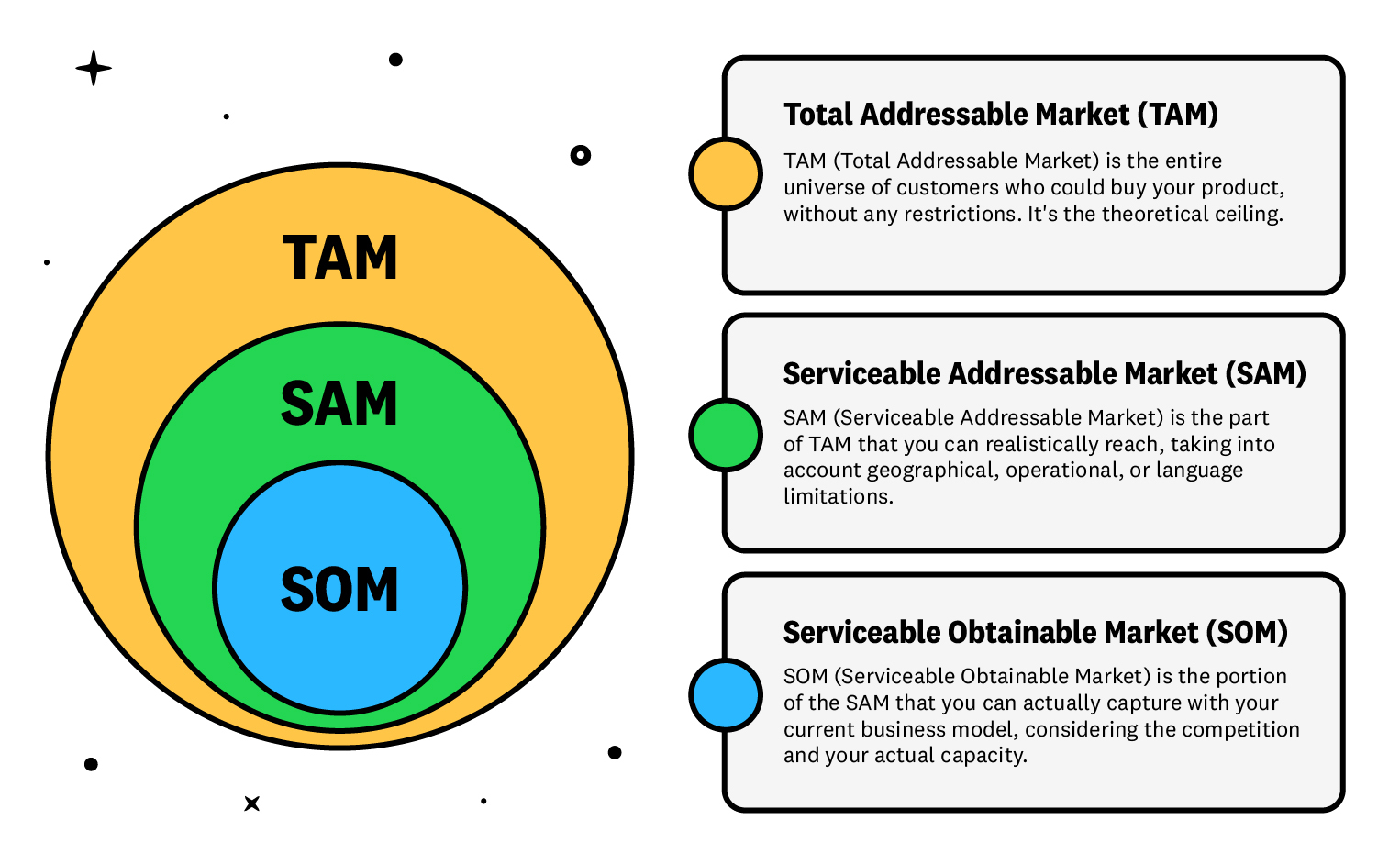
Let’s look at an example to understand it better.
Imagine a company that develops management software for restaurants and operates in Spain.
Their TAM is all the restaurants in the world that could use such a tool. Let’s say 500,000 businesses at €600/year: 300 million euros of potential market.
Their SAM is reduced to Spanish restaurants, where the company can operate and provide real support: 80,000 businesses × €600/year = 48 million euros.
Their SOM is even more specific. With their current team, they can only serve about 5,000 restaurants, and the competition already controls 60% of the accessible market. Their real obtainable market is approximately 2,000 restaurants × €600/year = 1.2 million euros.
The SOM is the number they work with today. The TAM is where they can grow.
How to Calculate TAM?
The calculation of TAM starts with a simple operation:

But the errors are not in the formula, but in the inputs.
The price has to be yours, not the competition’s. If your tool costs €300/year and the market leader charges €3,000/year, your TAM is ten times smaller than theirs. Using someone else’s price inflates the number and makes it useless for decision-making.
The same goes for the number of customers. They are not “everyone who has this problem,” but everyone who fits your real customer profile: sector, size, geography, buying behavior.
Top-Down Approach
The top-down method starts from global market data (industry reports, analyst studies, public statistics) and progressively narrows it down to the target segment.
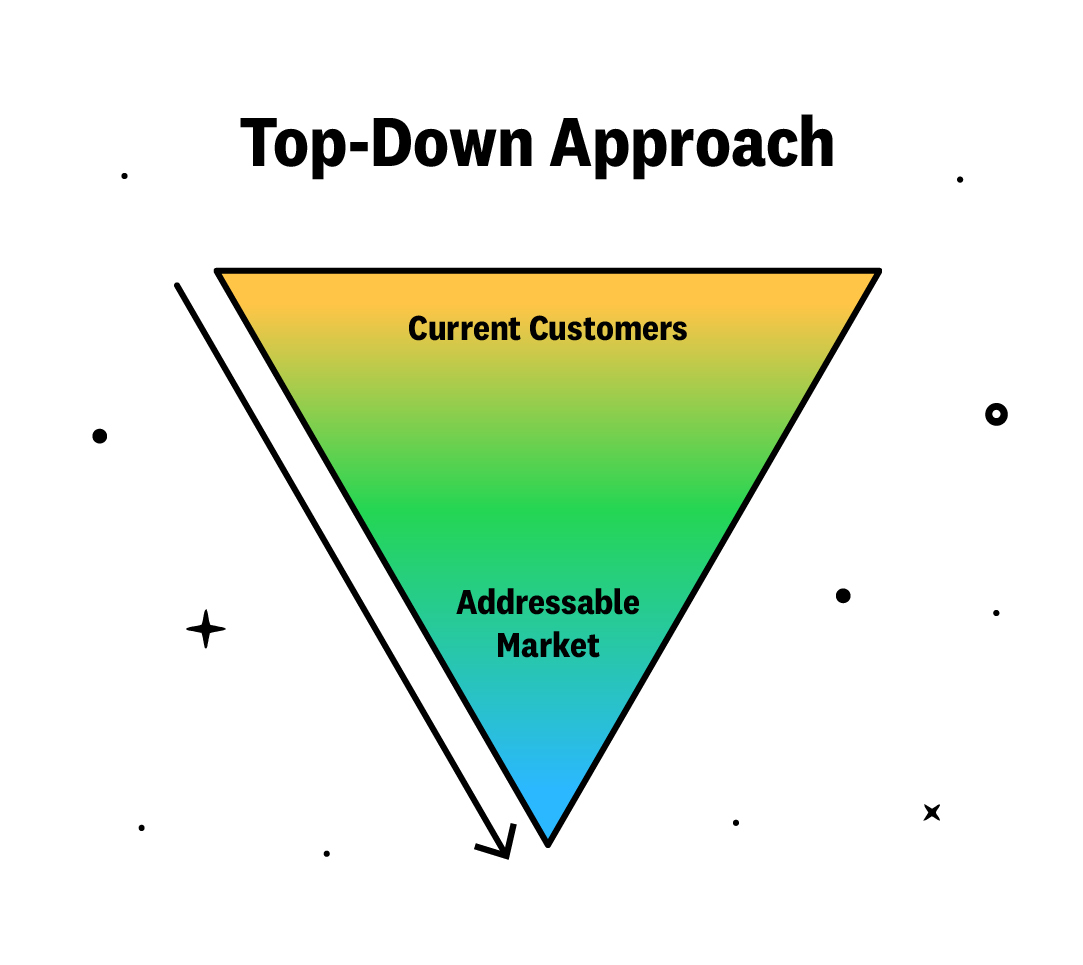
It’s the fastest approach and can be useful for a first estimate or when market data is solid and well-segmented.
But it has a clear trap: it’s the method that generates the famous “if I get 1% of the market, I already have a 100 million business.” That reasoning is not an analysis; it’s an illusion. Investors detect it immediately, and no serious strategic decision should rely on it.
Bottom-Up Approach
The bottom-up is the most laborious but gives a number you can really trust.
Instead of starting from the global market and cutting it down, it builds from the bottom up: a specific segment of well-defined customers is identified, the number is estimated, and it’s multiplied by the own price.
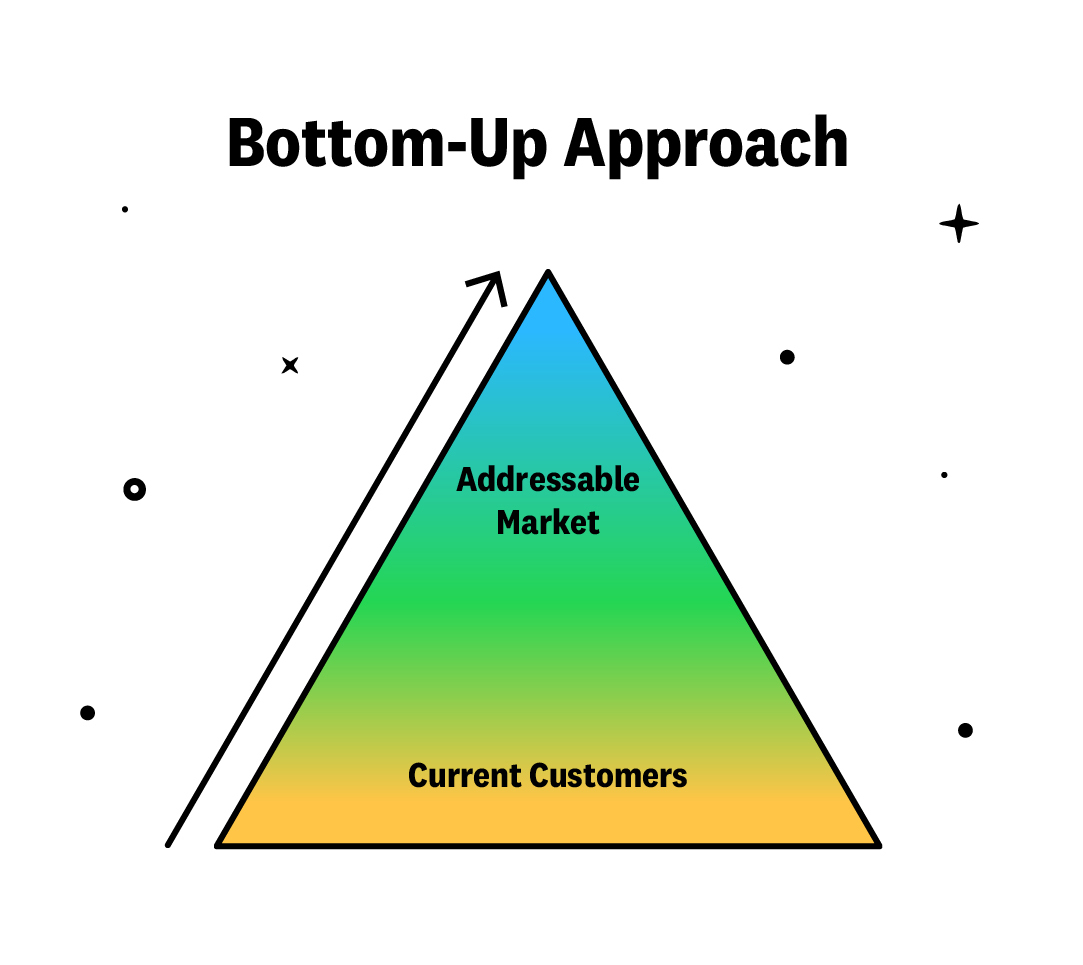
Returning to the restaurant software example: instead of starting from the global hospitality sector size, the company identifies that in Spain there are 80,000 restaurants with more than five employees, which is the profile that really uses their tool. That’s their starting point. Not the entire sector.
This method forces you to document each assumption, know the real customer, and be honest about the market size. That’s why it’s the favorite when proprietary data is available or when there’s already a pilot with real customers.
Value Theory
When there are no clear market references because of new products, categories that didn’t exist before… the TAM can be built from the value the product generates for the customer.
The logic is this: if there’s no reference price in the market, estimate how much a typical customer would be willing to pay for the value you provide. That price, multiplied by the number of potential customers, is your TAM.
An example: a startup developing an artificial intelligence tool to reduce customer service time. There’s no “AI for customer service” sector with published data. But they can calculate how much it saves in working hours for each customer using their tool and set a price based on that saving. That price × potential customers = TAM.
It’s the most subjective method of the three. Assumptions about willingness to pay must be well-founded, or the number loses credibility.
The Most Common Mistakes When Calculating TAM
Calculating TAM is not complicated, but there are recurring traps that turn a well-intentioned number into wasted paper.
Let’s look at some of them.
- The “if I get 1% of the market…” is the most widespread mistake
Starting from a 10 billion market and cutting 1% is not strategy; it’s illusions. TAM has to be built from the bottom up, not cut from the top down.
- Confusing the size of the problem with the market leads to figures that impress on paper but have no practical use
The market is not what the problem costs: it’s what customers would pay for your specific solution.
- Using the competition’s price instead of your own is another frequent mistake, especially in early stages when the price is not yet validated
If your product costs ten times less than the market leader’s, your TAM is ten times smaller. Assuming it early avoids surprises later on.
- Not documenting assumptions turns TAM into a number without support
Where does the number of potential customers come from? What source supports the average price? Showing the reasoning is as important as the final result, both for investors and the team itself.
- Calculating it once and forgetting it is perhaps the most silent mistake
TAM changes. A new customer segment, geographic expansion, or a price change can significantly alter the number. Reviewing it at least once a year is a practice worth installing.
To Conclude
A well-calculated TAM doesn’t have to be enormous for a business to make sense. A small, well-defined market is a better starting point than a giant, misunderstood market. What matters is that the number is real, documented, and reviewed as the business evolves.
If part of your strategy to reach that market involves email marketing, segmentation is where TAM becomes actionable: you don’t send to everyone, you send to those who fit your real customer profile.
At this point, Acumbamail allows you to build that segmentation from the first send, with lists, tags, and automations adapted to each contact’s behavior.