Brainstorming: what it is, how it’s done, and 10 tips for success
 Rocío Cortázar · 12 Feb, 2026 · Digital Marketing · 6 min

The brainstorming, or storm or brainstorm in Spanish, is a fundamental tool in the marketing world. It is a creative process aimed at generating innovative and effective ideas to tackle challenges, find solutions to problems… In this article, we will explore what brainstorming is, how it is carried out, and some key recommendations to ensure this technique produces the best results.
What is Brainstorming?
Brainstorming is an idea generation technique conducted in groups. Its main objective is to foster creativity and collaboration among participants to obtain a wide range of ideas (even if they are completely wild) in a short period of time. This technique is based on the premise that the quantity of ideas is more important than the quality in the early stages of the creative process. A central point is that team members are free to explore all angles and scopes; in fact, the best solutions can sometimes arise from the ideas that sound the craziest.
The concept of brainstorming was developed by Alex Osborn in the 1940s and has become a common practice in marketing and other fields. The central idea behind brainstorming is that by bringing together a group of people with different perspectives and experiences, unique and original ideas can be generated that otherwise would not have emerged.

How to conduct a Brainstorming session
The brainstorming process consists of several key stages that must be followed to achieve the best results:
1. Preparation
Before starting a brainstorming session, it is essential to clearly define the problem or challenge being addressed. The more specific the goal, the more effective the session will be. It is also important to select the right people to participate in the brainstorming, ensuring they have different backgrounds and perspectives; the more varied the profiles, the better.
2. Idea Generation
During this phase, participants gather and begin to generate ideas in a free and unrestricted manner. Active participation from all group members is encouraged, and negative criticism or judgments are completely avoided. Ideas are recorded without evaluating them at this point. Ensure that the space where the session is held is a pleasant, relaxed, spacious environment with all kinds of materials at hand (pencils, pens, paper, cards, boards…).

3. Discussion and Evaluation
Once a list of ideas has been generated, it’s time to evaluate and discuss them in depth. At this stage, questions can be asked to clarify the ideas and better understand their viability. It is essential that the environment remains open and that all group members continue to feel comfortable sharing their opinions.
4. Idea Selection
After a thorough discussion, the group must select the most promising and viable ideas. These are the ideas that will form the basis for developing concrete marketing strategies.
And with this, the Brainstorming session would be completed. All that remains is to make a plan to carry out the idea or ideas (assign tasks and responsibilities, establish a schedule, define necessary resources…), and execute them. Additionally, it is important to conduct constant follow-up to evaluate their effectiveness and make adjustments if necessary.
Recommendations for a successful Brainstorming
Now that you know how to conduct a brainstorming session, here are some recommendations to make your sessions as effective as possible:
1. Choose participants wisely and encourage diversity
Gather a group of people with different backgrounds, skills, and experiences. The diversity of perspectives can lead to more creative and varied ideas.

2. Establish an open environment and park judgments and criticisms (even non-verbal ones)
Create an environment where participants feel comfortable sharing their wildest ideas without fear of criticism. Creativity flourishes when people feel free to express themselves.
In this first stage, it is neither the time nor the place to evaluate ideas, and execution details should be avoided. The key is to think that, during the idea generation stage, there are no bad ideas; everything is valid and viable, and there will be time to analyze if they really are.
All participants should have equal opportunities to express themselves. The best ideas often come from professionals, students, and people who dare to think differently, and not necessarily only from highly trained and experienced managers.
It might even be a great idea to ban the word “no.” You’ll be surprised at how effective this tool is and how it helps open minds and create a collaborative, curious, and friendly idea environment.
3. Set a time limit
Limiting the time for the brainstorming session can help maintain energy and focus. Set a time limit for each phase of the process and stick to it. Generally, a brainstorming session will last between 15 and 60 minutes. It can be shorter or longer, depending on the difficulty of the problem and the motivation and experience of the group.

4. Record all Ideas
Make sure to record all ideas, even those that seem unconventional or wild. Sometimes, seemingly crazy ideas can lead to innovative solutions. Also, it’s easier to tone down a wild idea than to create a new one.
5. Encourage collaboration
As the saying goes, “1+1=3”, brainstorming stimulates idea building through a process of association. Encourage participants to build on each other’s ideas and work together to improve them. Collaboration can lead to stronger and more refined ideas. Our minds are highly associative, and one thought easily triggers another. By using others’ thoughts, we avoid getting stuck in our own thought structures.
As improv artists often advocate, say “yes and” instead of “but”. It takes practice, but this little trick works surprisingly well. You’ll find it very fun when team members initially have to say “yes” even to the strangest ideas. Giving half-baked ideas or strange suggestions is normally not socially accepted, and even (in many contexts) socially frowned upon, leading people to hold back in normal situations. Brainstorming deliberately gives permission to be “silly” and “childish.”
6. One conversation at a time
Try to ensure that only one person speaks at a time. Whether combining ideas, sharing ideas, or some other activity, during a brainstorming session, only one person should speak at a time. Avoid people interrupting each other; instead, have them jot down the ideas coming to mind so that when the current speaker finishes and they can contribute, they don’t forget anything.
7. Don’t cling to the first ideas
The first ideas are often the most obvious. Encourage the group to keep generating ideas even after identifying some good ones. Later ideas may be even better. Remember that one of the objectives is to achieve the highest number of ideas possible in the allotted time; here, quantity generates quality.
The more ideas generated, the higher the chances of finding an effective solution.
8. Be visual
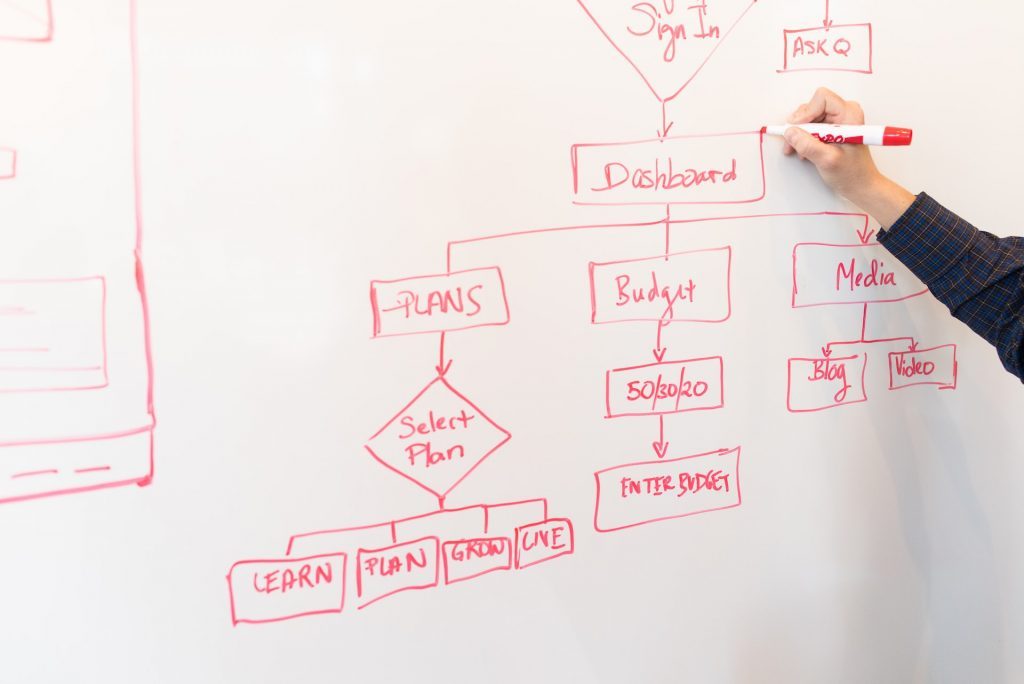
Nothing conveys an idea faster than a sketch. It doesn’t matter if you’re not good at drawing; what matters is the idea behind the sketch.
A simple flowchart can clearly communicate everything you want to say, without thinking in long sentences and, better yet, without anything being misinterpreted or lost. Simple shapes like circles, rectangles, lines, and arrows are more than enough to communicate ideas.
9. Be flexible
The brainstorming process doesn’t always follow a linear path. There may be setbacks and changes in direction. Be flexible and open to adapting your approach as needed.
10. Evaluate and refine
After the brainstorming session, evaluate and refine the selected ideas directly, don’t let more time pass than strictly necessary; now that the team is engaged and fully immersed in the creative process, it’s time to carry out as many stages as possible.
Ensure that the strategies are viable and suitable for achieving your marketing objectives.
Conclusions
Brainstorming is a valuable tool that can help you generate creative and effective ideas for your campaigns and strategies. By following the stages and recommendations mentioned above, you can conduct successful brainstorming sessions that help you stand out in an increasingly competitive market. Creativity and collaboration are key to success in the marketing world, and brainstorming is an effective way to foster both qualities.
Remember, the main rule to follow is: the more ideas, the better! Ideas should not be questioned or discussed at this stage; no one should feel that their ideas are too crazy.
As Albert Einstein once said:
“Si al principio la idea no es absurda, entonces no hay esperanzas”.
Foster an open and trusting environment to ensure a welcoming atmosphere where participants feel secure enough to offer their wildest (and potentially best) ideas.
Here’s a brainstorming session to give you a clearer idea of how it should be conducted; it’s in English, but it can still help clarify doubts.